What Is CPG? Consumer Packaged Goods Explained for New Brands
CPG is short for consumer packaged goods, the products people buy often, use up, and buy again, sold in a package through retail stores and online. Food and drinks, snacks, coffee, pet food, cosmetics, toothpaste, laundry detergent, and paper towels are all CPG. The category is defined by the buying pattern, frequent and low-involvement, and by the fact that the product reaches the shopper inside a pack, which is why packaging is the main place a CPG brand gets to speak.
If you are launching a food, drink, or personal care product, you are starting a CPG brand whether you use the term or not. This guide explains what the term covers, how CPG differs from FMCG and durable goods, how a packaged product gets from your kitchen or co-packer to a store shelf, and what all of that means for the pack itself.
CPG meaning in plain terms
A product is consumer packaged goods when three things are true at once:
- A consumer buys it for personal or household use. A restaurant buying the same sauce by the case is foodservice, a different business.
- It gets used up and replaced. A jar of pasta sauce lasts a week or two; a bottle of shampoo a couple of months. The purchase repeats.
- It is sold in a package, with a brand on it, through stores, delivery services, or online marketplaces.
The opposite is durable goods: a refrigerator, a bicycle, a sofa. Those are bought rarely, kept for years, and compared carefully before purchase. A CPG purchase takes seconds and is often made standing in front of a shelf, which changes everything about how the product has to be presented.
A few things sit at the edge. Over-the-counter medicine is usually counted as CPG, prescription drugs are not. Tobacco and alcohol are CPG with their own regulators. Fresh produce sold loose is a grocery product but not packaged goods; the same strawberries in a branded clamshell are.
CPG vs FMCG: is there a difference?
FMCG means fast-moving consumer goods. It is the term used in the UK, Europe, India, and most of the world for the same set of products that Americans call CPG. In day-to-day use they are interchangeable: a job at Unilever in London is an FMCG job, the same job at Procter & Gamble in Cincinnati is a CPG job.
When people draw a distinction, it is this: “fast-moving” describes how quickly the product sells through, and “packaged” describes how it is sold. So a strict reader would say every FMCG product is CPG, while a few CPG products are not especially fast-moving, like a premium skincare serum that a shopper replaces twice a year. In practice nobody polices the line. If you are writing for a US audience, say CPG; for an international one, FMCG.
CPG, FMCG, and durable goods at a glance
| CPG / FMCG | Durable goods | |
|---|---|---|
| Examples | Cereal, shampoo, dish soap, dog food | Washing machine, laptop, mattress |
| How often bought | Weekly to a few times a year | Every few years |
| Decision time | Seconds, often at the shelf | Days or weeks, with research |
| Price per unit | Low | High |
| Where the brand speaks | On the pack, in the aisle, in a thumbnail | Showroom, website, reviews, sales staff |
| What drives repeat purchase | Habit and recognition | Service, reliability, upgrades |
The middle row is the one that explains the rest of this guide. A decision made in seconds is made on what the eye can take in, which is the pack.
A third term you will see is “consumer goods” or “consumer products,” which is broader and includes durables. Apparel and electronics are consumer goods but not CPG.
What counts as CPG: the main categories
The usual way to carve up the industry is by what the product does and where it sits in the store.
- Food. Packaged grocery across the whole store: snacks, cereal, pasta and sauces, baked goods, confectionery, frozen meals, dairy, meat and seafood in branded packs, baby food, spices and condiments.
- Beverages. Soft drinks, water, juice, coffee and tea, energy drinks, beer, wine, spirits, and the newer ready-to-drink categories.
- Personal care and beauty. Skincare, hair care, oral care, deodorant, cosmetics, razors, feminine care.
- Household. Laundry and dish detergent, cleaners, paper products, trash bags, air care.
- Health and wellness. Over-the-counter medicine, vitamins and supplements.
- Pet. Pet food, treats, litter.
- Tobacco and nicotine, often tracked as a separate category.
Inside each category there are sub-categories that behave like separate markets with their own shelf, buyer, and rules. Frozen seafood and fresh seafood are both food, but they are different businesses with different packaging. Our guide to food packaging design goes through the main ones.
The biggest CPG companies, and why that matters less than it seems
The names everyone knows are Nestlé, Procter & Gamble, PepsiCo, Unilever, Coca-Cola, Mondelez, Kraft Heinz, General Mills, L’Oréal, and Colgate-Palmolive. Between them they own hundreds of brands, and a typical supermarket aisle is mostly their products arranged in a planogram they helped negotiate.
What matters for a new brand is the other half of the picture. Grocery shelves have been steadily opening up to small and regional brands, through natural and specialty retailers, direct-to-consumer sales, and marketplaces, and large companies now routinely buy the small brands that win a niche. The space exists; the question is whether a shopper who has never heard of you will pick the pack up.
How a CPG product gets to the shelf
The path from idea to a store is roughly the same for a granola and a face cream. Knowing the steps helps you see where packaging decisions get locked in.
Product and manufacturing. Most small brands use a co-packer or contract manufacturer instead of running their own plant. The manufacturer’s equipment decides which formats are available to you: a certain pouch size, a certain jar, a certain carton. This is the first packaging constraint, and it arrives before any design.
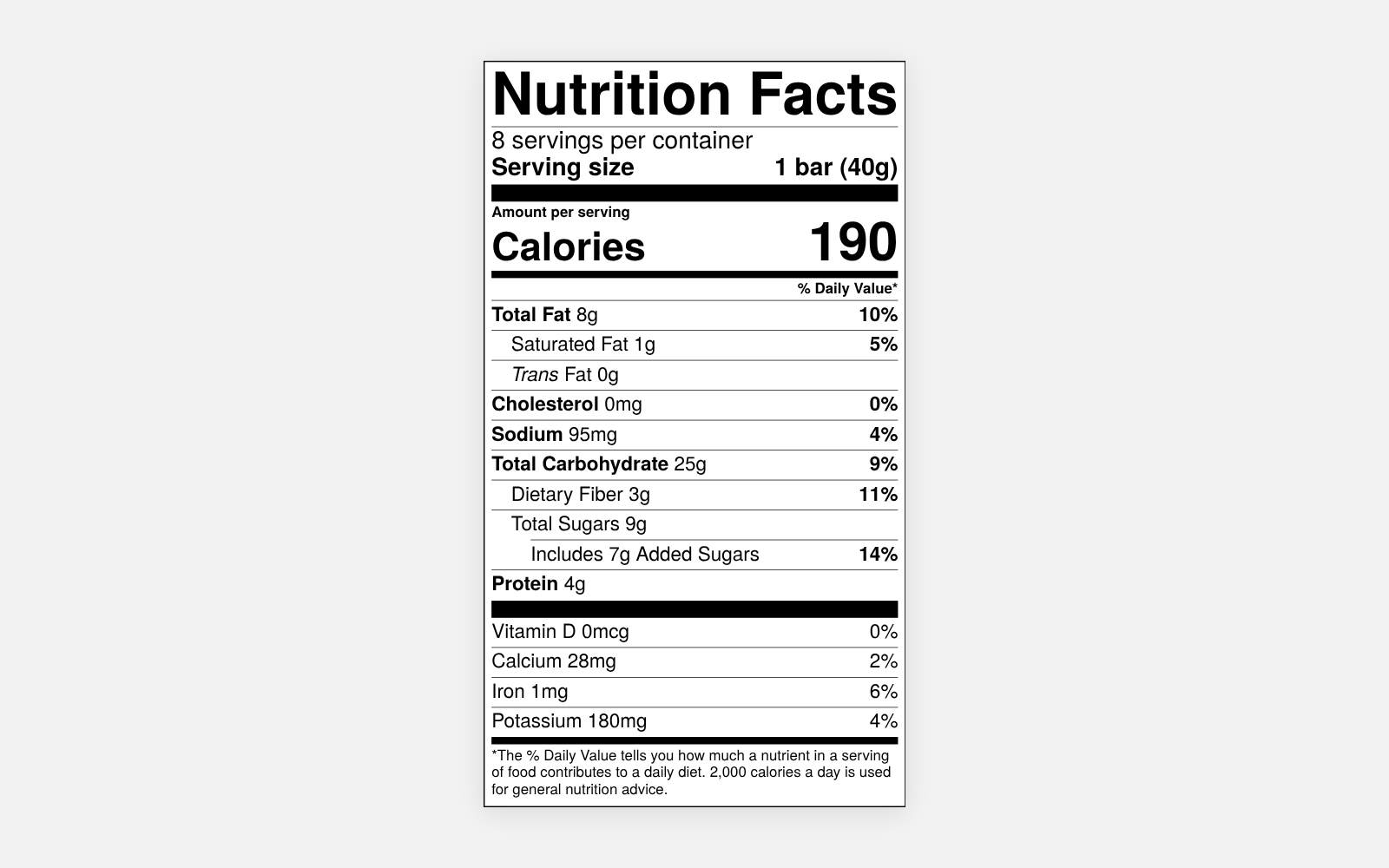
Compliance. Packaged food in the US falls under FDA labeling rules, with meat and poultry under USDA. The label has to show what the product is, how much is in the pack, the ingredient list, allergen declarations, a nutrition facts panel, and who makes or distributes it, each in a prescribed place and size. Personal care has its own rules, supplements their own, alcohol its own agency. We walk through the food rules in food label requirements.
Barcodes. Every retail SKU needs a UPC, which in the US means licensing a company prefix (or, for a handful of SKUs, single GTINs) from GS1 US and assigning a GTIN to each product and each size. The barcode has to be printed at a size and contrast a scanner can read, which has to be planned into the layout from the start.
Packaging design. With the format, the required text, and the barcode known, the design is built: the structure, the front panel that sells, the back panel that informs, and the system that will hold together as the range grows. Our packaging design process describes how this runs at a studio.
Distribution. You can sell direct from your website, through a marketplace like Amazon, to independent stores one by one, or through a distributor who sells to chains. Each channel has its own packaging needs: a shipping-safe carton for ecommerce, a case pack and pallet pattern for distributors, shelf-ready trays for some chains.
Retail. A buyer at a chain decides whether to list your product, often after a category review that most chains run once or twice a year. Listing fees, promotions, and shelf position are negotiated. Once you are on the shelf, the pack competes without you in the room.
Where CPG products are sold, and what each channel asks of the pack
The same jar of sauce can reach a shopper through six or seven different routes, and each one changes what the packaging has to do.
- Conventional grocery (Kroger, Albertsons, regional chains). The classic shelf: planograms, category reviews, the pack competing at arm’s length against twenty neighbors. Front-panel clarity and a strong brand block matter most.
- Mass and club (Walmart, Target, Costco). Larger formats, multipacks, and in club stores a pallet or tray that doubles as the display. Case and tray design become part of the brand.
- Natural and specialty (Whole Foods, Sprouts, independents). Often the first home of a small brand. Shoppers read more here, so ingredient callouts and certifications on the front earn their space.
- Convenience and drug (7-Eleven, CVS, Walgreens). Small facings and single-serve formats; the pack has to work at a glance from a crowded cooler or rack.
- Direct-to-consumer. Your own site. No shelf, so the shipping box and the unboxing carry the first impression, and the pack inside can be simpler.
- Marketplaces (Amazon above all). The product is first seen as a thumbnail. Packaging that reads at 200 pixels, with the variant and size obvious, sells; packaging designed only for a shelf often does not.
- Foodservice and wholesale. Bulk formats for restaurants and institutions, where the brand matters less and the label has to carry handling information.
Most brands start in one or two of these and add others. A system designed for a grocery shelf and then stretched onto Amazon and into Costco without a rethink usually ends up with three half-right packs. Deciding which channels matter in the first two years is a brief question, and the answer belongs in your packaging design brief.
The numbers retail buyers look at
A category buyer deciding whether to list a new product is looking at a few figures, and knowing them helps you understand why the pack matters so much to them.
- Velocity: units sold per store per week. A product that moves slowly loses its shelf space at the next review, so the buyer is guessing whether your pack will pull shoppers in.
- Margin: the retailer’s share after your wholesale price. Packaging cost sits inside your price, which is one reason over-engineered structures hurt a small brand twice.
- Trade spend: promotions, discounts, and in many chains a listing or slotting fee to get on the shelf. The pack needs a promotional version in mind, a multipack or a bonus size, before the first promotion arrives.
- Case and pallet efficiency: how many units fit in a case, how many cases on a pallet, and whether the case opens into a shelf-ready tray. These are secondary packaging decisions that a buyer sees before the shopper sees the primary pack.
None of these is a design question on its own, but each one is affected by format, size, and structure, which are decided during packaging design.
What the CPG model means for your packaging
Because the product is bought quickly and repeatedly, the pack has four jobs that a durable-goods brand can leave to a salesperson or a website.
Get recognized in a second. Shoppers scan a shelf; almost nobody reads it. A recognizable brand block, logo plus color plus one signature element, in the same place on every pack, is what makes the second purchase easy.
Explain the product without a conversation. What it is, how much, what flavor or variant, and one reason to choose it over the neighbor. The front panel has room for about that much and no more.
Carry the legal text without looking like a form. Everything the regulator requires has to fit, legibly, and still leave the front panel free to sell. Good packaging design treats the mandatory text as part of the layout from the first sketch.
Scale across a range. Almost every CPG brand adds variants, sizes, and new products. A packaging system designed for one SKU and stretched to ten usually breaks. Designing the system first is cheaper than redesigning it later; our guide to line extension vs brand extension explains how systems absorb new products.
How a CPG brand grows
Growth in packaged goods comes from three levers, and all three run through packaging.
Distribution. More stores and more channels carrying the product. Each new retailer may ask for a different case pack, a tray, a different size, or a private-label version. A system that can produce those variants quickly wins listings that a rigid one loses.
Velocity. More units per store per week. On the shelf this is recognition and a clear reason to choose; off the shelf it is sampling, promotion, and reviews, all of which point people back to a pack they then have to find.
Range. New flavors, sizes, and products. This is the lever small brands pull most, because a second SKU doubles facings on the shelf and gives the buyer a reason to keep the line. It only works if the new pack is obviously part of the family and obviously different, which is a system question decided on day one.
The brands that scale fastest tend to have packaging that was designed for the third lever before the first SKU shipped.
Examples from our work
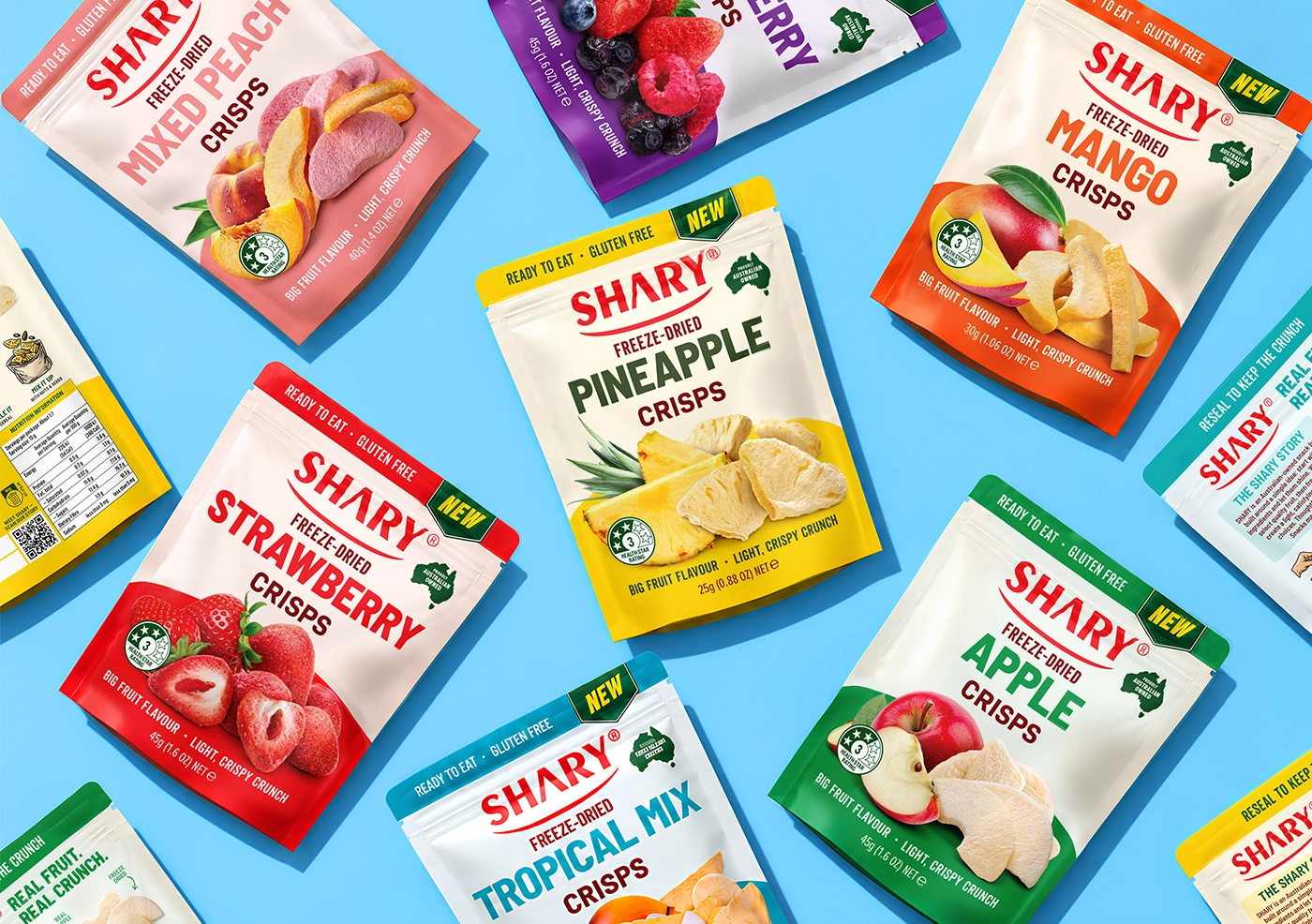
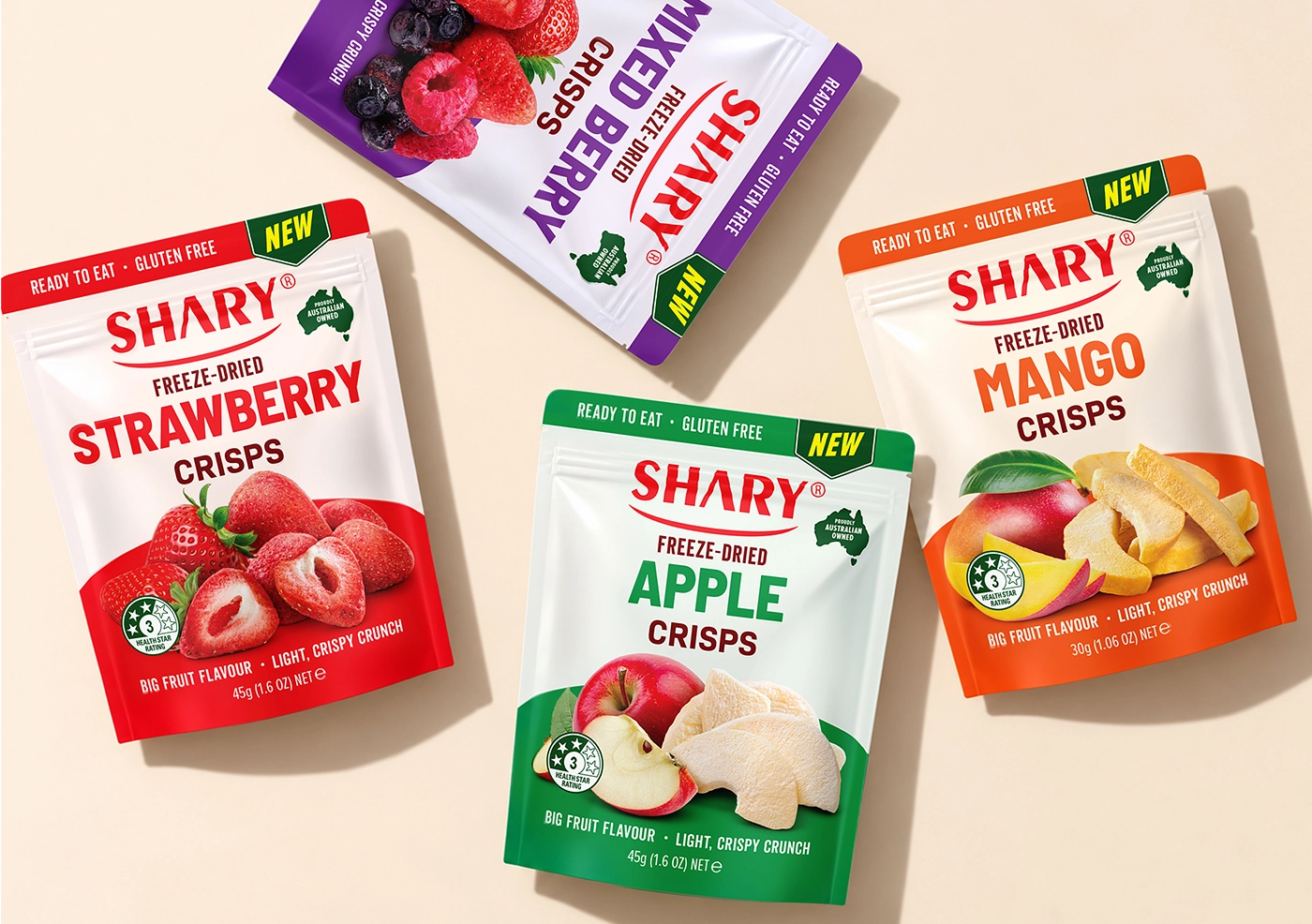
SHARY freeze-dried fruit crisps is CPG in its purest form: a snack in a stand-up pouch, bought on impulse and bought again, sold in seven flavors that have to be told apart in a second. The redesign kept the brand recognition the range already had and rebuilt the system around a bigger logo, color-coded panels per flavor, and photography that shows the fresh fruit next to the crisps, so the pack explains the product before anyone reads it. One system, seven color codes, room for more.
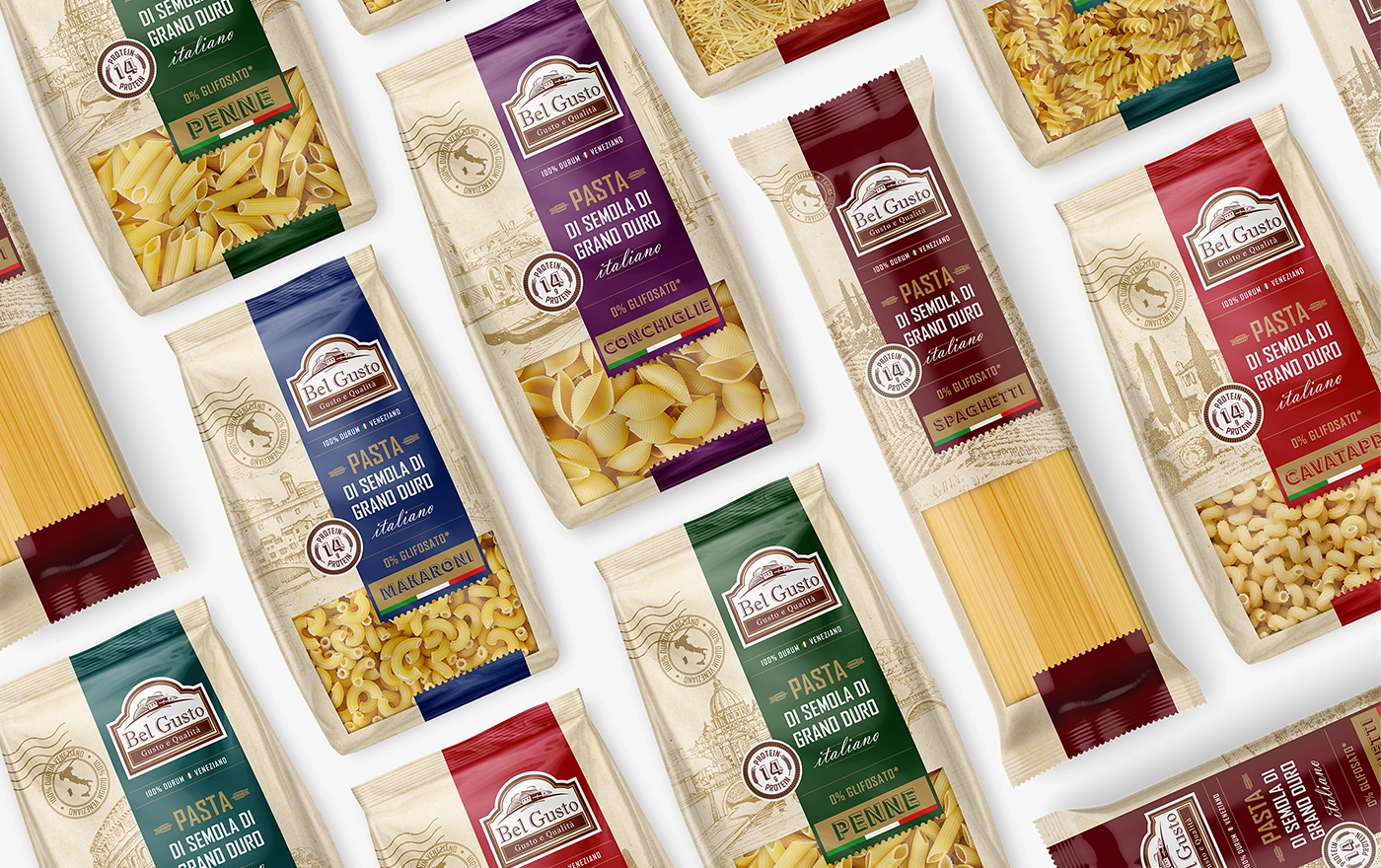
Bel Gusto is dry pasta, a category where every brand sits in the same aisle in nearly the same format. The design job was to make a pack read as authentic, premium Italian pasta, with a kraft texture, a window, and the idea of a parcel sent from Italy, without leaving the format a pasta buyer expects.
Spice Muse shows the range problem: one label system that had to work on jars, pouches, and tubes, with dozens of spices, so that the brand reads the same across formats while each product stays easy to find.


Bouncy Body is personal care, a different aisle from food: a coffee scrub series in pouches, where the pack had to carry a cosmetic brand’s playfulness and still meet the labeling that applies to products used on skin.

launching a packaged product?
tell us the category, the format and the retailers you’re aiming at: we’ll scope the packaging and send a fixed estimate in 1-2 business days
get quoteCPG trends that affect packaging right now
Three shifts a new brand should plan for, because each one lands on the pack:
Regulation is moving to the front panel. The FDA has proposed a front-of-package nutrition label (still not final at the time of writing), seven states have passed extended producer responsibility laws that charge brands by packaging material and the first programs are already collecting fees, and in California recyclability claims and the chasing-arrows symbol are now restricted by law. Expect more required elements competing for front-panel space, and leave room for them.
Channels are mixing. The same product has to work in a store, in a search result thumbnail on Amazon, and in a box arriving at a door. A pack designed only for the shelf often fails as a 200-pixel image.
Ranges are getting wider faster. Retailers want variety, and small brands launch flavors and formats to stay on the shelf. A packaging system that can take a new SKU in days is now a competitive requirement.
A first CPG launch checklist
Before you brief a designer or call a co-packer, it helps to have these settled:
- The category and sub-category, named the way a retailer names it, so you know whose shelf you are asking for.
- The format your manufacturer can run, with its dieline or container spec.
- The required label elements for your product type, listed, so the front panel is designed around real text.
- A GS1 company prefix and a GTIN for every SKU and size.
- The two or three channels you will sell through in the first year.
- The range you expect in two years: flavors, sizes, a second product. The system should be built for that, even if only one SKU ships first.
- A budget that separates design from print, because they are different suppliers and different numbers.
With these in hand, a packaging project moves fast. Without them, the first design round is spent discovering them.
Other meanings of CPG
The abbreviation shows up outside consumer goods, which is why search results sometimes mix them:
- In healthcare, a CPG is a clinical practice guideline, a published set of recommendations for treating a condition.
- In finance and investing, “CPG” usually still means the consumer packaged goods sector, as in a CPG stock or a CPG fund.
- In some companies it is a department name, the consumer products group.
If you came here from a medical or finance context, those are different things with the same three letters.
Working in CPG
A “CPG job” is a role at a brand, retailer, or supplier in this industry: brand management, category management, sales to retail buyers, supply chain, trade marketing, packaging development, and the design and research vendors around them. For a founder, the relevant point is that most of these roles exist on the other side of the table too. The buyer reviewing your product and the category manager deciding your shelf position are CPG professionals with their own metrics, and your packaging is one of the few things they can evaluate without a meeting.
What CPG packaging design costs
Through our packaging design services, a packaging system for a first SKU is priced from $2,500, additional variants run about $800 each, and a label design for a container you already have starts at $1,500. The ranges by format are in our packaging design cost guide, and the fastest way to get a real number is to fill in a packaging design brief with your format, range, and retailers.
SOTDESIGN works out of Albany, New York, and has completed 80+ packaging projects for consumer brands in 10+ years. We do design only; the print-ready files go to your manufacturer or printer. SOTDESIGN is a branding and packaging design agency that works with CPG brands from the first SKU to a full range.
ready to put your product on the shelf?
design only, files for any printer or co-packer · fixed estimate in 1-2 business days
get quoteFAQ
01 What does CPG stand for?
Consumer packaged goods. The term covers everyday items sold in a pack and bought over and over: groceries, drinks, toiletries, cleaning products, pet food, and the like.
02 What is CPG vs FMCG?
They describe the same products. CPG is the US term, FMCG (fast-moving consumer goods) is used in the UK, Europe, and Asia. FMCG stresses how fast the product sells, CPG stresses that it is sold packaged.
03 What are examples of CPG products?
Cereal, chips, pasta, coffee, soft drinks, beer, yogurt, frozen meals, pet food, shampoo, toothpaste, deodorant, laundry detergent, paper towels, and over-the-counter medicine.
04 What is the biggest CPG company?
By revenue the largest is Nestlé, followed by PepsiCo, Procter & Gamble, Unilever, and Coca-Cola. Rankings shift year to year with currency and acquisitions.
05 Is Amazon a CPG company?
No. Amazon is a retailer and marketplace that sells CPG products, including its own private-label brands. A CPG company makes and markets the packaged products themselves.
06 What does CPG mean in healthcare?
In medicine, CPG means clinical practice guideline, a published recommendation for diagnosing or treating a condition. It is unrelated to consumer goods.
07 Why does packaging matter so much in CPG?
Because the purchase happens in seconds at a shelf or in a search result, with no salesperson. The pack has to be recognized, explain the product, meet labeling law, and work across the whole range.
08 How do I start a CPG brand?
Settle the product and a manufacturer, learn the labeling rules for your category, license a UPC from GS1 US, design a packaging system built for the range you expect, and pick the two or three channels you will sell through first. Most of the cost and risk sits in manufacturing and distribution; the packaging is where the brand gets decided.