Food Label Requirements: What the FDA Requires on a Packaged Food Label
A packaged food sold in the US needs six things on its label under FDA rules: a statement of identity (the name of the food), the net quantity of contents, an ingredient list, an allergen declaration for the nine major food allergens, a Nutrition Facts panel unless the product qualifies for an exemption, and the name and place of business of the manufacturer, packer, or distributor. Required information must be in English (and repeated in any other language you add) and easy to read.
The rules also say where each item goes. The name of the food and the net quantity belong on the principal display panel, the part of the package shoppers see first. The ingredients, allergens, Nutrition Facts, and the business name and address go together on the information panel, usually the panel immediately to the right of the front, with nothing else placed between them and in type no smaller than 1/16 inch.
The FDA doesn’t approve labels before they go to market, so getting this right is the brand’s job. Meat and poultry products above certain thresholds fall under USDA instead. Below we go through each requirement and the numbers people most often get wrong, then look at how the rules shape a label’s design before anyone starts drawing.
The required elements at a glance
| Element | Where it goes | Main rule |
|---|---|---|
| Statement of identity | Principal display panel | The common or usual name of the food, in bold type, in a size reasonably related to the most prominent text |
| Net quantity of contents | Principal display panel, bottom 30% | Weight, measure, or count in US and metric units, with a minimum type height set by panel size |
| Ingredient list | Information panel (or front) | All ingredients by common name, in descending order by weight |
| Allergen declaration | With the ingredient list | The nine major allergens, named in the ingredients or in a “Contains” statement |
| Nutrition Facts | Information panel (or front) | Required unless the product or the company qualifies for an exemption |
| Name and place of business | Information panel (or front) | Manufacturer, packer, or distributor, with city, state, and ZIP |
The FDA’s Food Labeling Guide is the best plain-language starting point, and the regulations themselves sit in Title 21, Part 101 of the Code of Federal Regulations. What follows is a practical summary, not legal advice. A regulatory consultant or food attorney should review your final label.
The principal display panel and the information panel
Every label decision starts with two areas of the package. Mark them on the dieline before any design work begins.
The principal display panel (PDP) is the part of the label most likely to be seen when the product sits on the shelf. On a box, that’s the whole front: height times width. On a jar, bottle, or can, the FDA counts 40% of the height times the circumference as the PDP area, and the required front information has to fit within that 40% of the wrap (21 CFR 101.1). Shoulders, necks, lids, and flanges don’t count. If a package has two fronts, say a pouch that could face either way, the required front information goes on both.
The information panel is the panel immediately to the right of the PDP as you face it (21 CFR 101.2). If that space can’t be used, for example because it’s a folded flap or the end of a can, the next panel to the right takes its place. The ingredients, Nutrition Facts, and the business name and address go there (or on the PDP), all on one panel when space allows, and in one block without other material in between. Marketing copy, illustrations, and certification seals can’t sit between the ingredient list and the Nutrition Facts.
The general minimum type size for required information is 1/16 inch, and FDA guidance measures it by the height of the lowercase “o.” The Nutrition Facts panel has its own type-size rules. On a small label, that one number decides how much text physically fits, so check it early, well before the proof.
1. Statement of identity
The statement of identity is the name of the food. It has to be one of the main features of the PDP (21 CFR 101.3), and it comes with a few rules of its own.
- If federal regulations set a standard name for the food, such as “ice cream” or “peanut butter,” you have to use it, and the product has to meet the standard. If there’s no standard, use the common or usual name. A brand or fanciful name is fine as a brand, but the label still needs a plain name that tells shoppers what the food is.
- If the form of the food matters and isn’t visible, state it: sliced, diced, whole, ground.
- Set the name in bold type, in a size reasonably related to the most prominent printed matter on the panel, and in lines generally parallel to the base of the package.
A common design mistake is to set the brand name huge and the statement of identity as a whisper underneath it. Leading with the brand is fine, as long as a shopper can still find the name of the food.
2. Net quantity of contents
The net quantity tells shoppers how much food is in the package: by weight for solids, by fluid measure for liquids, or by count. Federal packaging law requires it in both US customary and metric units, for example “Net Wt 12 oz (340 g),” and the FDA’s guide says the same.
The placement and size rules are some of the most specific on the whole label (21 CFR 101.105):
- It goes on the PDP, as a distinct item, in the bottom 30% of the panel, in lines parallel to the base. The bottom-30% rule doesn’t apply when the PDP is 5 square inches or smaller.
- It needs clear space around it: above and below, at least the height of the lettering; on the sides, at least twice the width of the letter “N” in that type.
- The minimum type height depends on the size of the PDP:
| PDP area | Minimum type height |
|---|---|
| 5 sq in or less | 1/16 inch |
| More than 5, up to 25 sq in | 1/8 inch |
| More than 25, up to 100 sq in | 3/16 inch |
| More than 100, up to 400 sq in | 1/4 inch |
| More than 400 sq in | 1/2 inch |
Two details often catch designers out. When you use upper and lower case, the height is measured on the lowercase letters, so a stylish small x-height can push you under the minimum. The letters also can’t be more than three times as tall as they are wide, which rules out very condensed fonts for this line.
The net weight excludes the container and wrappers, and for some products it excludes more. FDA’s position, for example, is that the net weight of glazed frozen seafood doesn’t include the ice glaze. We cover that and other freezer-specific rules in our frozen food packaging design guide.
3. Ingredient list
If a food has more than one ingredient, the label lists them all by their common or usual names, in descending order of predominance by weight (21 CFR 101.4). The heaviest ingredient comes first.
When an ingredient is itself made of several ingredients, such as chocolate chips in a granola, you have two options. You can name it and list its own ingredients in parentheses: “chocolate chips (sugar, chocolate liquor, cocoa butter).” Or you can drop the compound name and fold its components into the main list in the right order. The first is easier for shoppers to read and usually easier to keep accurate when a supplier changes.
Of everything on the label, the ingredient list is the part most likely to grow without warning. A recipe tweak, a new supplier, or a flavor extension can add a line, so give it some room in the layout.
4. Allergen declaration
Federal law names nine major food allergens: milk, eggs, fish, crustacean shellfish, tree nuts, peanuts, wheat, soybeans, and sesame. Sesame joined the list on January 1, 2023. If your food contains any of them, including as part of a flavoring or a processing aid, the label has to say so in one of two ways (FDA: food allergies):
- In the ingredient list, with the allergen’s name in parentheses where it isn’t obvious: “whey (milk),” “lecithin (soy).”
- In a “Contains” statement placed immediately after or next to the ingredient list: “Contains: wheat, milk, soy.”
For tree nuts, fish, and crustacean shellfish, you name the specific kind: “almonds,” “cod,” “shrimp.” The FDA’s 2025 guidance update also clarified that milk from goats and sheep and eggs from ducks or quail count as major allergens and should name the animal, and it removed coconut and several other nuts from the tree nut list.
Statements like “may contain” or “made in a facility that also processes peanuts” are voluntary. The FDA doesn’t set their wording, but they have to be truthful and shouldn’t stand in for good manufacturing practices. On the label, keep them close to the allergen information so they read as one block.
5. Nutrition Facts
Most packaged foods need a Nutrition Facts panel. Its content and format are set in detail by 21 CFR 101.9, so the designer’s job is to choose the right format and fit it cleanly.
The standard panel is vertical. If the package doesn’t have enough continuous vertical space, a side-by-side tabular version is allowed. Packages with 40 square inches or less available for labeling can use a smaller tabular format, or a linear one if even that won’t fit. And when a package contains at least 200% and up to 300% of the food’s reference amount (roughly two to three servings), it generally needs a dual-column panel that lists nutrition for one serving and for the whole package, which takes noticeably more width.
On a very small package, where the total surface available for labeling is under 12 square inches, the panel can be left off, as long as the label carries no nutrition claims or other nutrition information and gives an address or phone number where shoppers can get the information.
Many early-stage brands are covered by one of two small business exemptions (FDA small business nutrition labeling exemption guide):
- A business that sells directly to consumers, which the FDA calls the retailer exemption, is exempt without filing a notice if its annual gross sales are no more than $500,000 or its food sales to consumers are no more than $50,000. A brand that sells through distributors and stores usually doesn’t qualify for this one.
- A business with fewer than 100 full-time equivalent employees that sells fewer than 100,000 units of a product in the US per year can claim an exemption for that product by filing a notice with the FDA every year. Very small firms, with fewer than 10 employees selling fewer than 10,000 units, don’t need to file, unless they import the food.
Any nutrition claim cancels the exemption. Put “high protein,” “no added sugar,” or “good source of fiber” on the pack, or any other nutrition information on the label, in labeling, or in advertising, and you need the full panel. If a claim is part of your positioning, plan for the panel. And if you expect to grow past the thresholds within a year, design the space for the panel now. Retrofitting a panel into a finished label usually means redesigning the back.
6. Name and place of business
The label must name the company responsible for the food: the manufacturer, the packer, or the distributor (21 CFR 101.5). If your company didn’t make the food, which is common when a co-packer produces it, the name gets a qualifier such as “Manufactured for” or “Distributed by.”
The address includes the city, state, and ZIP code. The street address can be left off if your company is listed in a current city or telephone directory. Most brands also add a website, which isn’t required but is where curious shoppers go next.
need a compliant label that still sells?
send us your product list and current copy: fixed estimate in 1–2 business days
get quoteClaims change what the label has to show
Claims add their own rules on top of that baseline, and several of them cancel the nutrition exemption described earlier.
- Nutrient content claims like “low fat,” “high fiber,” or “reduced sodium” have defined meanings and conditions. Using one requires the Nutrition Facts panel even for an otherwise exempt small business.
- “Healthy” now has a new FDA definition based on food groups and limits on saturated fat, sodium, and added sugars. The rule took effect in April 2025, and products using the claim must comply by February 25, 2028 (FDA: use of the term “healthy”).
- “Gluten-free” means the food contains less than 20 parts per million of gluten (21 CFR 101.91).
- “Organic” and the USDA Organic seal are controlled by the USDA’s National Organic Program. Under USDA rules, operations that make or pack organic products generally need their own certification as well as the farm.
So decide on claims before the design starts, and get each one confirmed by whoever is responsible for your regulatory review. A claim added at proof stage can change the back panel as well as the front.
What federal rules don’t require (but buyers may)
Some things people assume are mandatory aren’t, at least not under federal food labeling rules:
- Date labels. Apart from infant formula, federal law doesn’t require “best by” or “use by” dates (USDA FSIS: food product dating). Retailers and distributors usually expect them, and some states have their own rules for certain foods. Plan a clear spot for a printed or stamped date.
- A UPC barcode. It isn’t an FDA requirement, but nearly every retailer requires one, so treat it as mandatory if you sell through stores.
- Front-of-package nutrition box. In January 2025 the FDA proposed a “Nutrition Info box” on the front of most packaged foods, showing saturated fat, sodium, and added sugars. As of October 2026 it has not been finalized (FDA: front-of-package nutrition labeling). It’s worth watching, because if it’s finalized, many fronts will need room for it.
Who regulates your label
Not every food label answers to the FDA:
- Most foods follow FDA rules, as described above.
- Meat and poultry products above set thresholds, generally more than 3% raw or 2% or more cooked meat or poultry, fall under USDA’s Food Safety and Inspection Service, which has its own label rules and approval process.
- Most alcoholic beverages, such as beer, wine, and spirits, fall under the Alcohol and Tobacco Tax and Trade Bureau (TTB). Some, including wine under 7% alcohol and beer not made from malted barley and hops, follow FDA labeling rules instead.
- Homemade foods sold under cottage food laws follow state rules, and those vary a lot. Many states require a specific statement that the food was made in a home kitchen that isn’t inspected. Check your state agriculture or health department before printing.
For FDA-regulated foods, the agency doesn’t approve individual labels before they go to market (FDA: is it really FDA approved?). Compliance is the brand’s responsibility, which is why a final review by a regulatory professional is worth the cost.
How the rules shape the label design
Good label design starts from the required elements. On our projects, the work goes in this order:
- Map the PDP and the information panel on the dieline first. On a jar or bottle, calculate the 40% PDP area and decide where the front sits on the wrap. That area, not the full wrap, sets the minimum type size for the net quantity.
- Size the information panel for the real copy. That means getting the final ingredient list, allergen statement, and nutrition data, then choosing the Nutrition Facts format that fits. A dual-column or tabular panel can force a wider back label or a different shape.
- Build the front hierarchy around the legal name. The front usually carries the brand, the product name, the statement of identity, the one or two claims that sell, and the net quantity in its bottom-30% zone, and only a few of those can be loud.
- Design the system for every format and size. A brand that sells the same product in a jar, a pouch, and a tube has three different PDPs and possibly three different minimum type sizes, and the system has to work on the smallest one.
- Find a spot for lot codes, dates, and price stickers where they won’t land on the ingredient list.
- Before print, run the proof against a checklist like the one below and have your regulatory reviewer sign off on the final files.
Most of this information should be collected in the packaging design brief before the design starts. Missing regulatory copy is one of the most common reasons a label project stalls.
Two label systems from our work
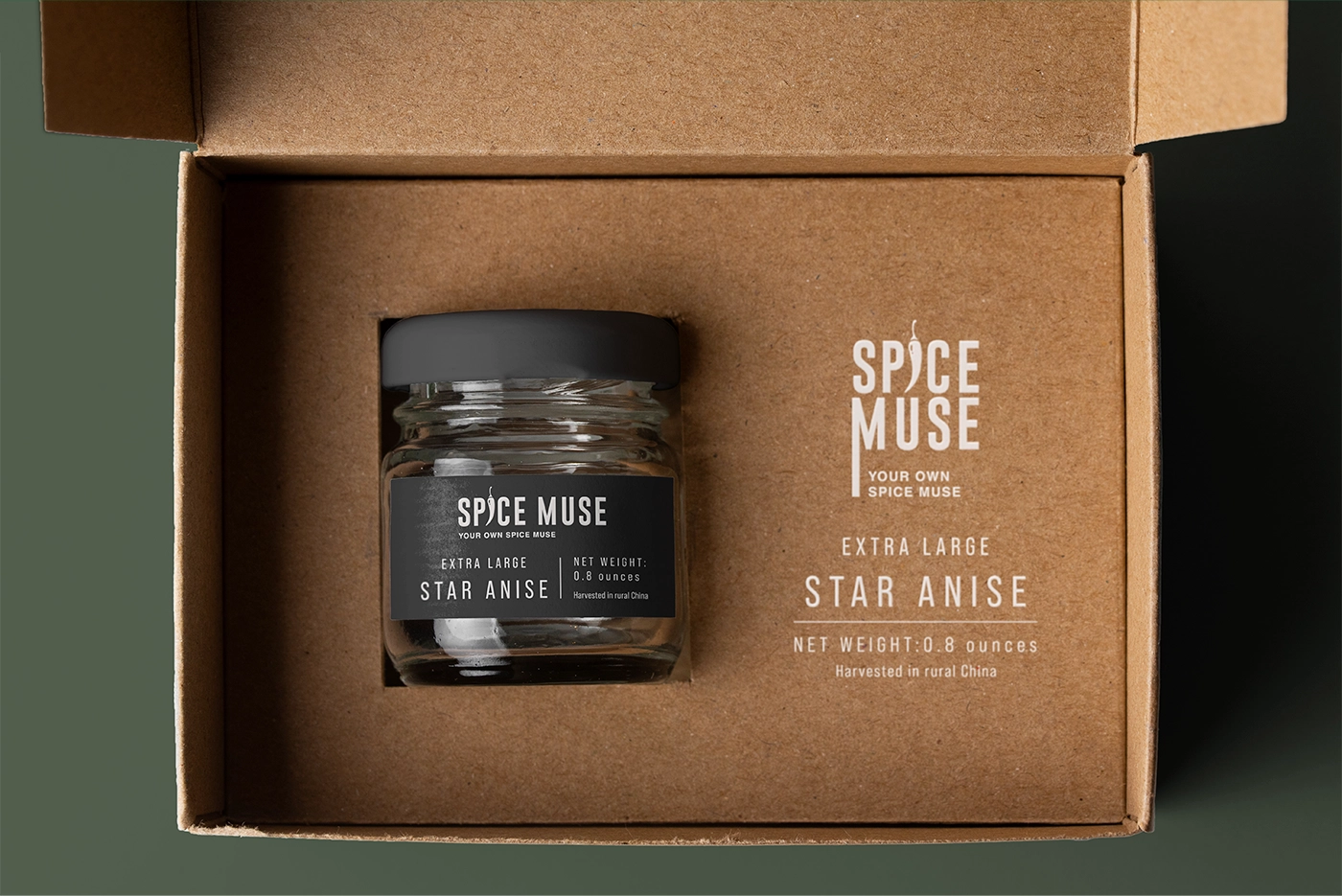
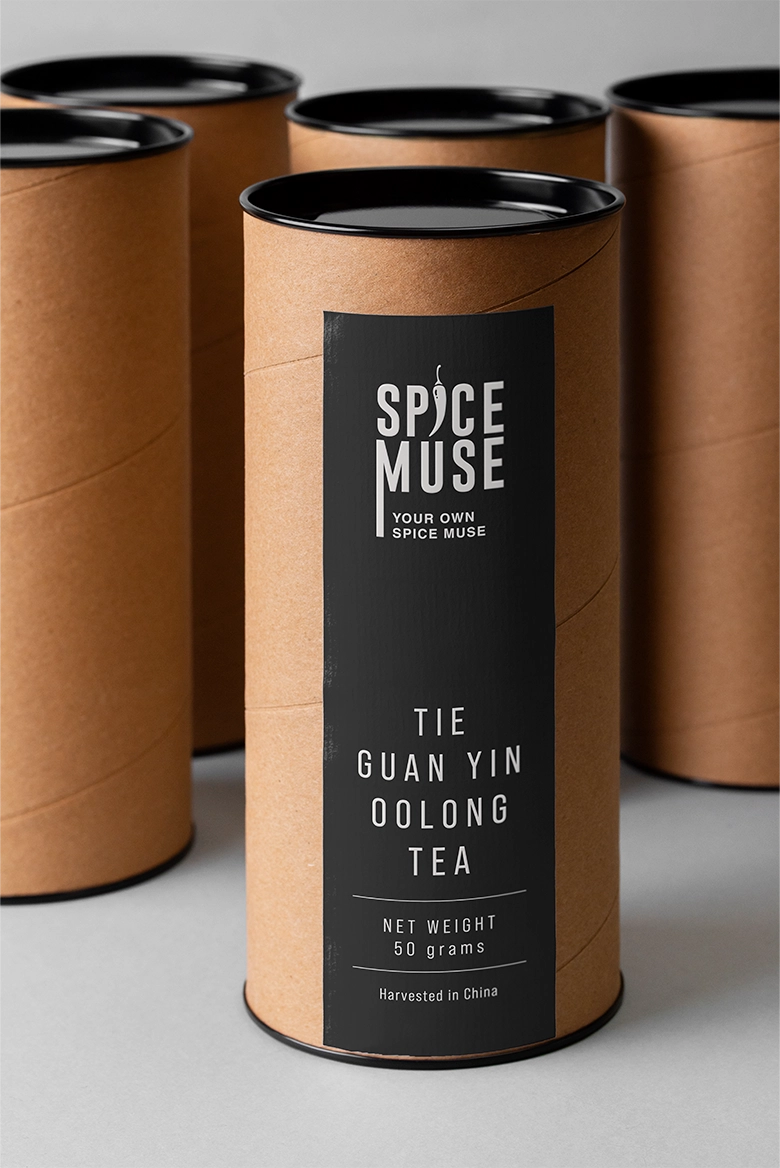
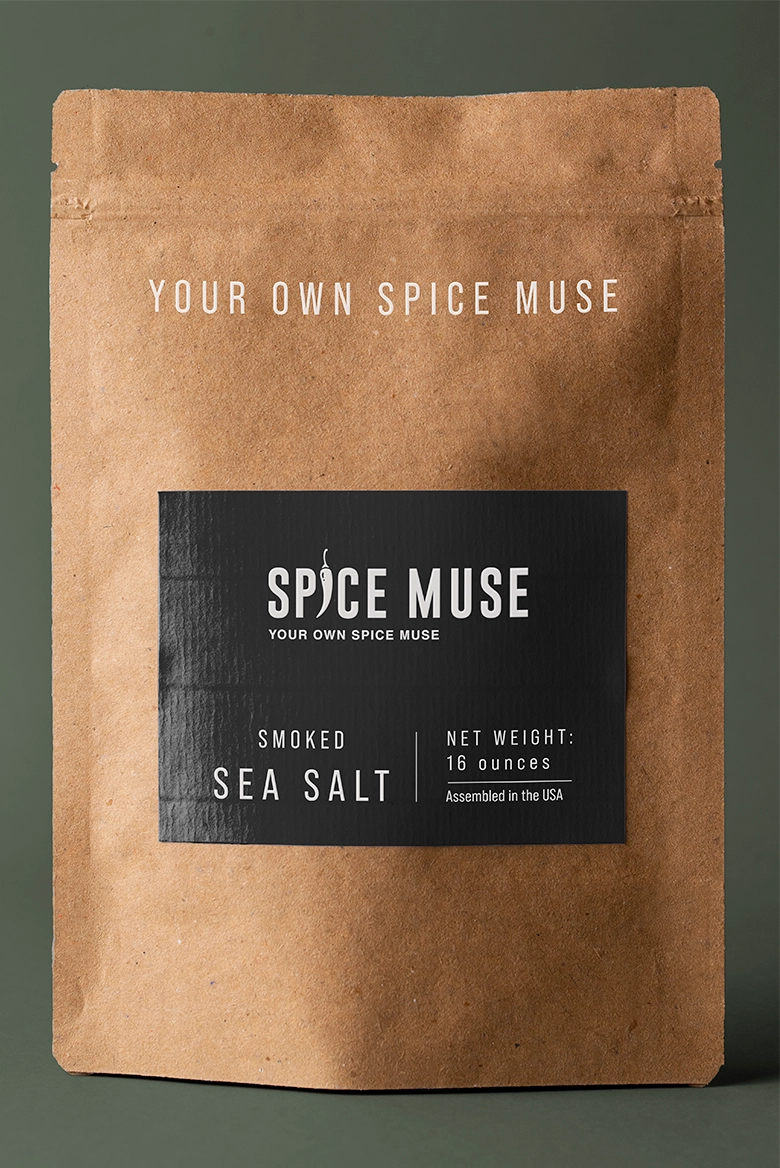
For Spice Muse, a premium spice, salt, and tea brand, the same label system had to work on glass jars, resealable kraft bags, and cylindrical cardboard tubes, with the product name, weight, and sourcing information clearly shown on every pack. We built it on matte black labels with white and silver type and a custom logo, and kept the typography consistent across every format.
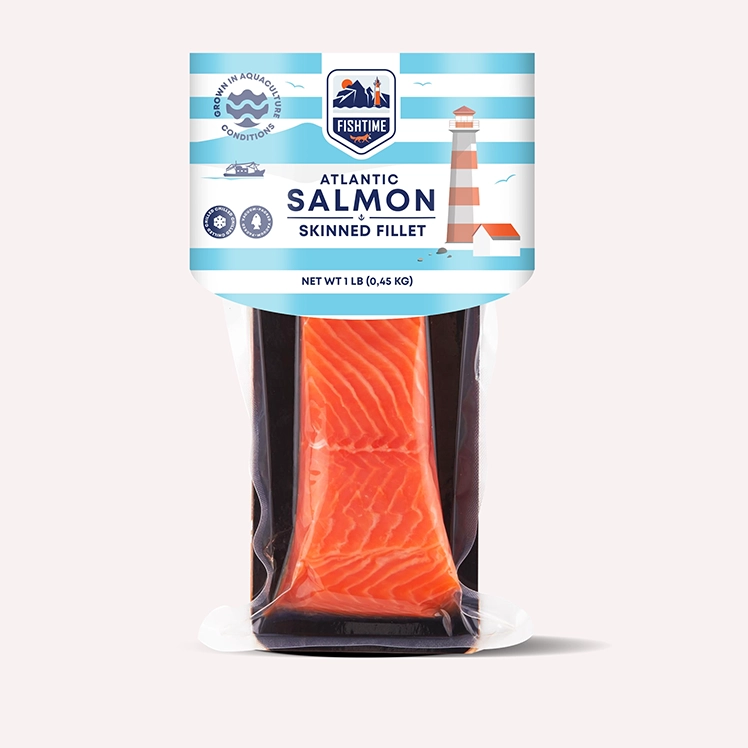
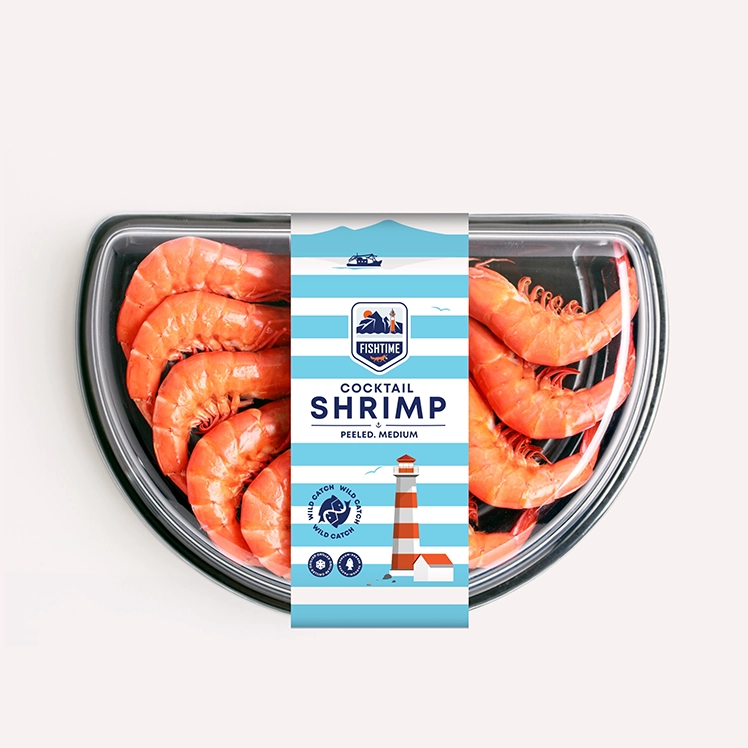
Fishtime is a line of more than twenty new shock-frozen fish and seafood products. Its packaging needed to earn trust and signal freshness at a glance, and a range that large had to stay consistent on retail chain shelves. The logo and the packs are built around a flat illustration of a lighthouse over calm water and distant mountains, used in cool tones on every product, and we also delivered a brand book that sets out logo use, palettes, typeface, and tone of voice, so each new product follows the same rules. With a range that size, a fixed layout for the required information keeps twenty labels consistent. Seafood also has a few label rules of its own, such as using the FDA’s accepted market name for each species.
On projects like these, the designer lays out the required information so it fits the formats and stays legible. The brand and its regulatory reviewer approve the wording and the claims. It helps to agree on that split at the start of any label project.
Food label checklist before you print
Front (PDP)
- Statement of identity: correct common or standard name, bold, prominent, parallel to the base.
- Net quantity in US and metric units, in the bottom 30% of the PDP (if it’s larger than 5 sq in), at or above the minimum type height, with clear space around it.
- Claims confirmed and supported.
Information panel
- Ingredients in descending order by weight, with sub-ingredients.
- Allergens declared in the ingredient list or a “Contains” statement, with specific tree nut, fish, or crustacean shellfish names.
- Nutrition Facts in the right format, or a documented exemption.
- Name and place of business, with “Manufactured for” or “Distributed by” if needed.
- All of the above in one block, no intervening material, at least 1/16 inch type.
Production
- UPC barcode away from seams and folds; on round containers, turn the bars so they don’t wrap around the curve.
- Space reserved for dates and lot codes.
- Final copy approved by your regulatory reviewer, on the final proof.
What label design costs and how we work
Our label design services start at $1,500, and the fixed estimate covers your full product list. Three concepts and three rounds of revisions come with every project, and most go from kickoff to print-ready files in two to three weeks. When the label is one piece of a bigger packaging system, our guide to how much packaging design costs explains how full packaging projects are priced.
The studio is in Albany, New York, and we’ve worked in branding and packaging for 10+ years. Most of our 80+ packaging projects for consumer brands across the US have been food and beverage. We only design and don’t print, so we build the files on your printer’s label specs, and they’ll work with any printer.
ready to design your food label?
send us your product list and copy: fixed estimate in 1–2 business days, design only, any printer
get quoteFAQ
01 What are the required elements of a food label?
Under FDA rules: the statement of identity, the net quantity of contents, the ingredient list, the allergen declaration for the nine major allergens, the Nutrition Facts panel unless exempt, and the name and place of business of the manufacturer, packer, or distributor.
02 Do I need a nutrition label to sell food?
Usually yes, but small businesses can be exempt. A retailer selling directly to consumers with no more than $500,000 in annual gross sales, or no more than $50,000 in food sales to consumers, is exempt. A business with fewer than 100 full-time equivalent employees selling fewer than 100,000 units of a product a year can file an annual notice with the FDA for an exemption. Any nutrition claim or other nutrition information on the label cancels the exemption.
03 Does the FDA approve food labels?
No. The FDA doesn’t approve individual food labels before they go to market. The brand is responsible for compliance, so it’s worth having a regulatory professional review the final label. Some meat and poultry labels go through a USDA approval process instead.
04 What font size is required on a food label?
Required information on the information panel generally must be at least 1/16 inch tall, measured by the lowercase “o” under FDA guidance, and the Nutrition Facts panel has its own type-size rules. The net quantity has its own minimum, from 1/16 inch on a front panel of 5 square inches or less up to 1/2 inch on panels larger than 400 square inches.
05 Where does the net weight go on a food label?
On the front panel, as a separate item in the bottom 30% of the panel, in both US and metric units, for example “Net Wt 8 oz (227 g).” The bottom-30% rule doesn’t apply when the front panel is 5 square inches or smaller.
06 Do food labels need an expiration date?
Not under federal law, except for infant formula. Most retailers expect a date, and some states have rules for certain foods, so most brands print a “best by” date.
07 What are the labeling rules for homemade food?
Foods made at home and sold under cottage food laws follow state rules, which vary widely. Many states require a statement that the food was made in a home kitchen that isn’t inspected by a health department. Check with your state’s agriculture or health department.
08 How much does food label design cost?
At SOTDESIGN, label design starts at $1,500, with a fixed estimate for your full product list, three concepts, and three rounds of revisions. Costs rise with the number of products, sizes, and formats.