Bakery Packaging Design: A Practical Guide for Bakeries and Baked Goods Brands
Bakery packaging has to protect the product, because baked goods leak grease, lose moisture, go stale, and crush easily. It has to show the product, since shoppers judge bread, cookies, and pastries by how they look, whether that’s through a window, in a photo, or in an illustration that makes them hungry. And it should tell people quickly what they’re getting: the item, the flavor, how fresh it is, and what’s in it, including allergens.
Most bakeries don’t need a separate design for every item. A system works better: a few box and bag sizes with the brand built in, plus labels or stickers that change by product, flavor, and season. Brands that sell packaged baked goods through grocery stores need more than that. They need fully printed packaging that reads from a few feet away and carries the full FDA label information.
At SOTDESIGN, a packaging system plus the first product starts at $2,500, and label design starts at $1,500. This guide walks through the formats that work, how to show the product, how to build a system that covers dozens of items, what to plan for allergens and dates, and ideas for bread, cookies, cakes, and pastries.
Two kinds of bakery packaging
“Bakery packaging” covers two very different businesses, and the right design approach depends on which one you run.
| Bakery, café, or patisserie | Packaged baked goods brand | |
|---|---|---|
| Where it sells | Over your own counter, online, at markets, sometimes to cafés | Grocery and natural stores, Amazon, your website |
| Typical packaging | Stock boxes and bags with branding, stickers, labels, ribbons | Printed pouches, cartons, bags, trays with flow wrap |
| What the design has to do | Make the box feel special, keep the brand consistent across many items, open well | Stand out on a shelf, show the flavor fast, carry the full label |
| Labeling | Depends on how and where you sell; check federal and state rules | Full FDA labeling, unless an exemption applies |
| Biggest risk | Every item looking different, a brand that doesn’t hold together | Blending into the aisle, a range shoppers can’t tell apart |
Plenty of growing bakeries end up in both columns, with cakes and pastries at the counter and a line of cookies or granola going into local stores. That’s usually when a consistent packaging system starts to pay off.
Formats and materials
You’ll usually pick the format with your packaging supplier, but each one changes what the design can do.
| Format | Common for | Design notes |
|---|---|---|
| Bakery box with or without a window | Cakes, pastries, cookie assortments, donuts | The lid carries the brand; a window shows the product but limits artwork |
| Cake box with insert | Whole cakes, cupcakes | Depth and strength matter; branding often goes on a band or sticker |
| Paper bag with or without a window | Bread, croissants, cookies to go | Grease-resistant paper; front panel is narrow and tall |
| Plastic bread bag with clip or tie | Sliced bread, buns, bagels | The bag front is the main panel; the clip or tag can carry the date |
| Stand-up pouch | Cookies, granola, biscotti | Large front, can be resealable, good for grocery and online |
| Tray with flow wrap | Brownies, bars, snack cakes | Small surface; the design goes on the wrap and often on an outer carton |
| Tin or gift box | Holiday cookies, gift assortments | Higher cost; the design has to work as a keepsake |
| Sleeve or belly band | Boxes, trays, bundles | Turns a plain stock box into a branded product at low cost |
Whatever you choose has to handle grease and moisture. Butter and oil soak through ordinary paper and leave stains that make a premium product look cheap. Bread dries out in paper, and crusty bread goes soft in plastic. Grease-resistant coatings, moisture barriers, and the right board are decisions for your supplier, who knows what each material does to shelf life. Tell your designer what you’ve picked, because it affects how colors print and how the pack looks after a day in the case.
People also tend to underestimate strength. A cake box that bends when you pick it up, or a cookie pouch that shows up full of crumbs instead of cookies, hurts the brand more than any design detail could. If you ship, put the pack through real shipping before you commit to it.
Showing the product: windows, photos, and illustration
With baked goods, the product itself usually does the selling, so most of the design work comes down to how you show it.
A window lets shoppers check the crust, the color, and the size, and that builds trust. It has trade-offs, though. It lets in light, it can fog from condensation if warm products are packed too soon, and anything not quite perfect is on display. Put the window over the part of the product that looks best, keep the branding and the product name clear of it, and make sure it works for every item that goes into that box or bag.
For packaged goods sold in grocery stores, a large, honest product photo is often the strongest choice. Just make sure it matches what’s inside. A cookie that looks twice as big on the pouch as in it leads to disappointed buyers who don’t come back.
Illustration fits patisseries, gift lines, and premium cookies well. It can say more about the brand than a photo can, from the neighborhood to the ingredients to the style of baking. It also ages well and works across every product, since it doesn’t need to change when the menu does.
A lot of bakeries mix these. They’ll put an illustrated brand pattern on boxes and bags, then add a window or a product photo for the items that need to sell themselves.
One system for dozens of products
A small bakery can easily sell forty items, and printing a different box for each one isn’t realistic. So the packaging becomes a system, with a few parts that stay fixed and a few that change.
The fixed parts are the logo, the color palette, the brand pattern or illustration, the typography, and the box and bag sizes. Two or three box sizes and two bag sizes often cover a small bakery’s range.
What changes from item to item is a label, sticker, or belly band that names the product, the flavor, and the date, and carries the ingredients and allergens where they’re needed. If the sticker also seals the box, it’s doing two jobs at once.
On top of that sits a seasonal layer: a limited sleeve, a holiday sticker, or a special ribbon color. It gives regulars a reason to notice you again, and you don’t have to redesign the brand to do it.
This approach also keeps costs down. Stock boxes with a printed logo, or plain boxes with a well-designed sticker, have low minimums. Fully custom printed boxes look great but usually need larger runs, so they make the most sense for your best-selling items and for gift packaging.
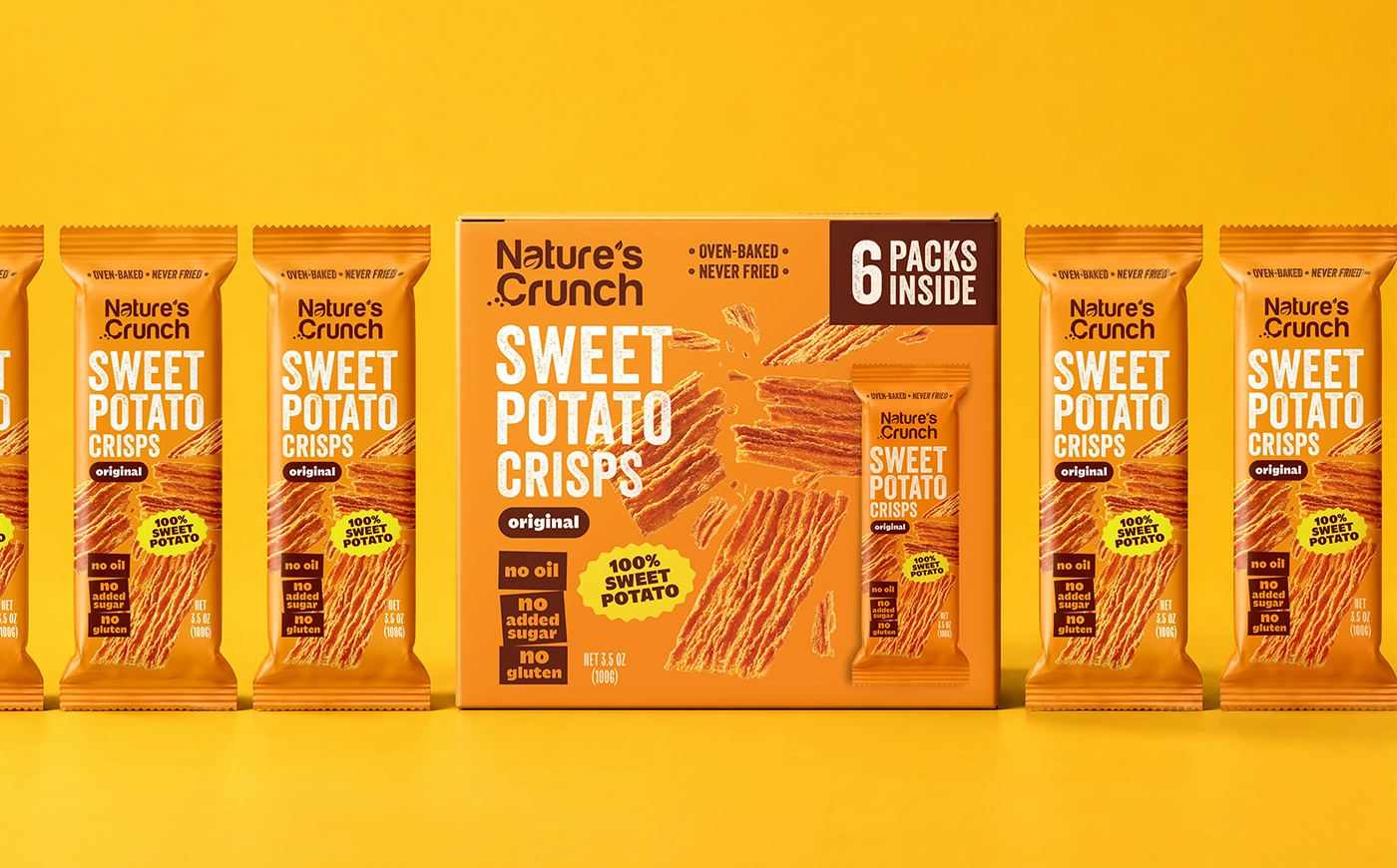
Packaged baked goods brands use the same idea on printed packaging. One layout runs across the range, with a clear way to tell products apart, and color is usually the fastest signal. A shopper should be able to find the chocolate chip cookies without reading the label.
Freshness, dates, and shelf life
Freshness is one of the first things bakery customers look for, so make it easy to see.
- Federal rules don’t require date labels on baked goods, but customers look for them, and retailers usually expect them. A “baked on” date suits fresh bread and pastries. A “best by” date suits packaged cookies and snacks with a longer shelf life. Either way, plan a clear spot for the date: a sticker, a printed field, or the bag clip.
- Short storage and serving tips like “Best enjoyed within two days,” “freeze for up to a month,” or “warm at 350°F for 5 minutes” improve the experience and cost nothing to add.
- Shelf life drives the format. A croissant that’s best the same day and a cookie with a six-week shelf life need different packaging. Work out your shelf life first, with your supplier and, for retail lines, a shelf-life test, and then design for it.
Allergens matter more in bakeries
Bakeries routinely handle seven of the nine major food allergens: wheat, milk, eggs, tree nuts, peanuts, soy, and sesame. Packaged foods have to declare any of the nine major allergens they contain, either in the ingredient list or in a “Contains” statement (FDA: food allergies).
Sesame shows how much allergens can shape a bakery’s choices. It became the ninth major allergen on January 1, 2023. Because tiny sesame seeds are hard to clean out of shared equipment, some large commercial bakers chose to add a small amount of sesame to products and declare it, rather than risk undeclared traces. The FDA commissioner at the time said the agency didn’t support that practice, and allergy and consumer groups pushed back (NPR, August 2023). If you run a smaller bakery, know exactly what’s in each product and what it shares equipment with, and make the allergen information easy to find.
That affects the label design in a few ways.
- Leave real space for the allergen statement on every label, close to the ingredients, in readable type.
- Keep “may contain” statements truthful and next to the allergen information, so the two read as one block.
- Give allergen-friendly lines their own family with a distinct look, so a gluten-free or nut-free product can’t be confused with the regular version. A “gluten-free” claim has a legal definition, including a limit of under 20 parts per million of gluten (21 CFR 101.91).
Labeling rules for baked goods depend on how and where you sell them. Under federal rules, ready-to-eat items you bake and sell only in your own shop are generally exempt from Nutrition Facts, and very small businesses may qualify for their own exemption, as long as the label makes no nutrition claims. Those exemptions cover only the Nutrition Facts panel. Items you pack ahead of time generally still need a name, ingredients, allergens, and your business details. Selling online, at markets, or through other stores can change what applies, and state and local rules add their own layer. We go through the federal basics in our guide to food label requirements.
need a bakery packaging system?
boxes, bags, labels, or all three: send us your product list and get a fixed estimate in 1–2 business days
get quoteDesign for the way you sell
The same box behaves differently depending on where customers meet it.
At the counter. The customer has already chosen, so the packaging is there to make the purchase feel like a treat and to carry your brand home. Put the logo on the lid, make the box easy to carry, and think about the moment it opens. A printed inside lid, a pattern, or a short thank-you line gives people a reason to take photos.
In the grocery bakery aisle. Now the pack has to win attention from a few feet away, next to big national brands. You need a clear product name, a strong product image, a flavor color you can spot from a distance, and some restraint on the front. Packaged bread sits on racks where only the top half of the bag may show, so put the brand and the product name high.
Online and shipped. Customers see a thumbnail first, then a box that has spent a few days in transit. Check that the brand reads at thumbnail size, and design the inside of the package too, whether that’s an insert that holds cookies in place, a tray for cupcakes, or a card with storage tips.
Markets and pop-ups. Keep it bright, simple, and easy to read from the other side of the table. A consistent look across the whole stand matters more than any single box.
Wholesale to cafés. Your product may sit in someone else’s display case, often without its packaging. A small label, a branded bag for takeaway, or a card for the café counter keeps your name attached to it.
Ideas by type of baked good
- Bread. Let the loaf show through a window or a clear bag, and put the bread type and the date where they’re easy to find. Bread shoppers buy by type, such as sourdough, whole wheat, or multigrain, so make the type the biggest thing on the pack and use color to separate the range.
- Cookies. Lead with flavor, using a big product photo or a strong color for each one. Pouches and window boxes both work. For gifting, a tin or a printed box with an illustrated pattern raises the perceived value.
- Cakes and patisserie. The box is part of the gift. Illustration, a refined logo, and a calm palette usually suit premium patisseries better than loud graphics. Make sure the box opens cleanly without damaging the decoration.
- Croissants and pastries. Grease is the main problem here. Choose grease-resistant paper and keep the most important artwork away from the areas that touch the product.
- Brownies and bars. These are small, often individually wrapped, and often sold near the register. The wrap needs one clear message and the flavor, and the outer carton carries the brand on the shelf.
- Gluten-free and allergen-friendly. Give the line a separate look nobody can mistake, with the claim stated clearly and backed by your process.
- Holiday and seasonal. Use the same system with a seasonal element, so the product feels special but still looks like you.
Common bakery packaging mistakes
- Giving every item its own look. Over time the counter starts to look like five brands, and a simple system fixes that.
- Grease stains on a premium box. A stained box costs you more in reputation than the right material costs in money.
- A window that shows the wrong thing. If it was sized for one item, it can show the box insert, crumbs, or an empty corner when a different product goes in.
- No space for the date and allergens. Squeezed onto a tiny sticker, they’re hard to read right when customers need them.
- Packaging that can’t travel. Boxes that crush or pouches that let cookies break turn online orders into refunds.
- Designing only for the counter and then going wholesale. A box that looks great in your shop may not read on a grocery shelf, so if stores are in your plans, design the packaged line for the shelf from the start.
Examples from our work
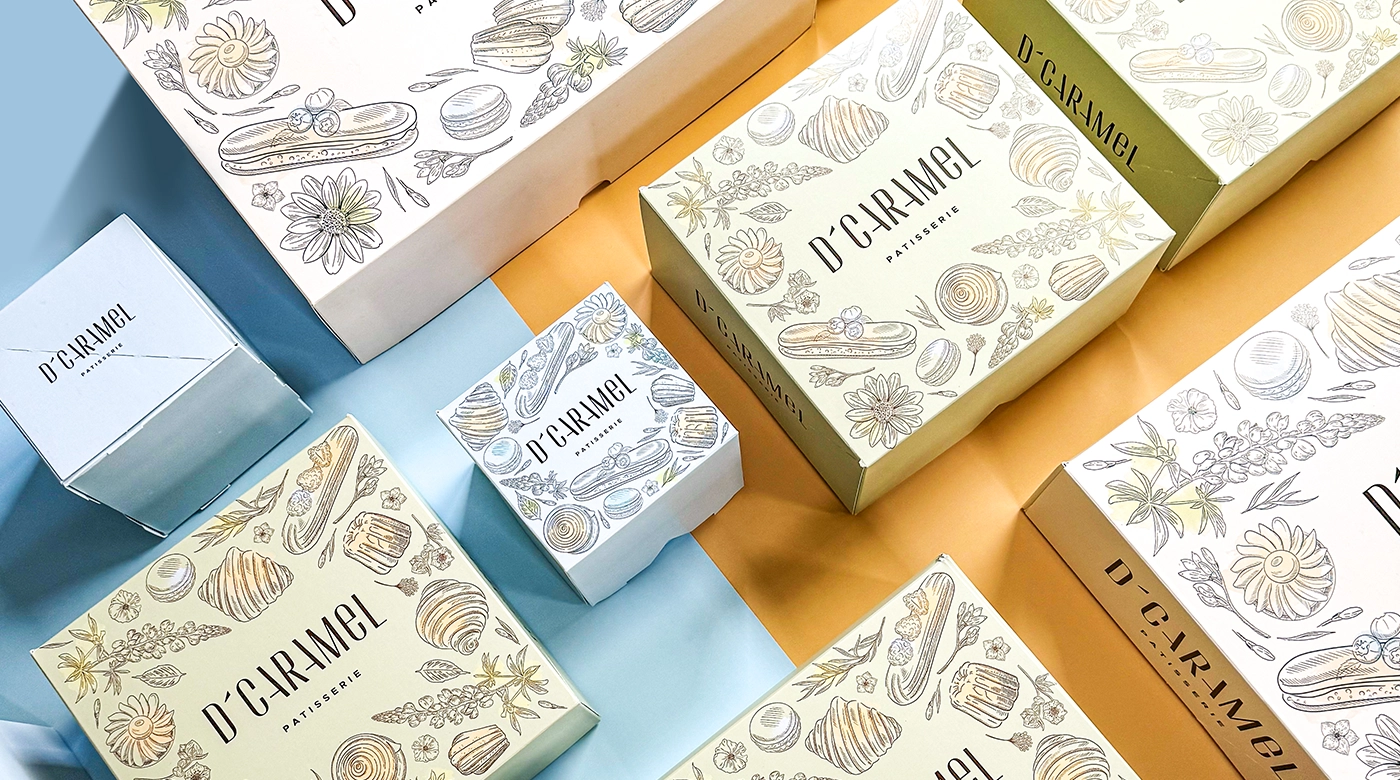
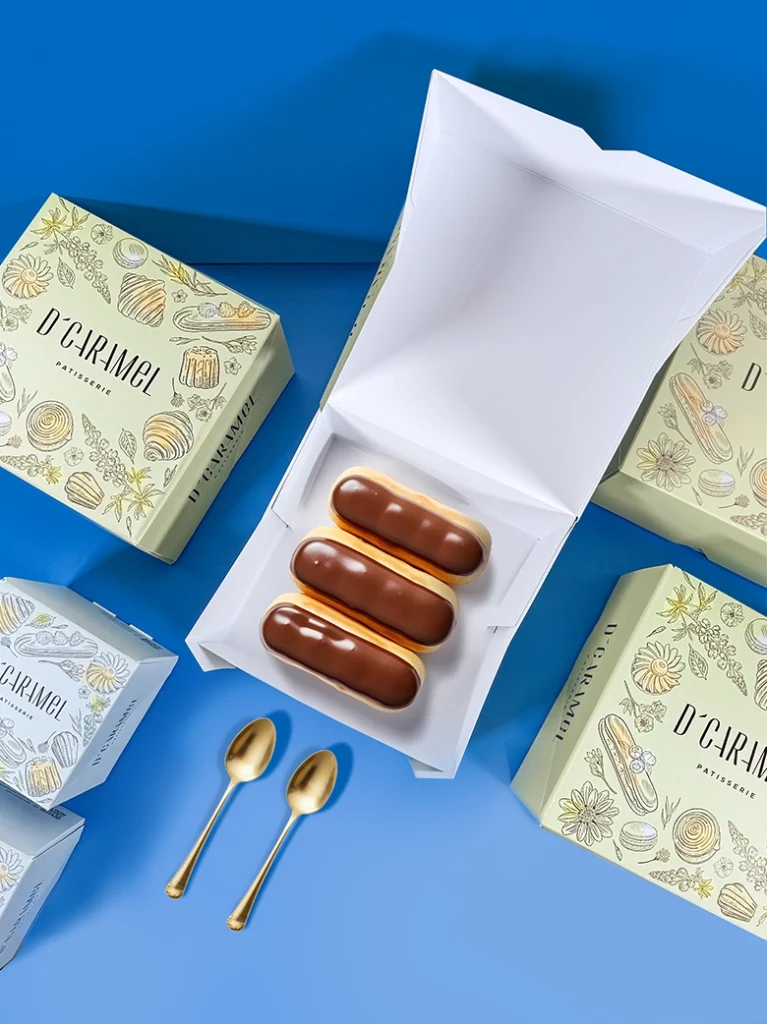
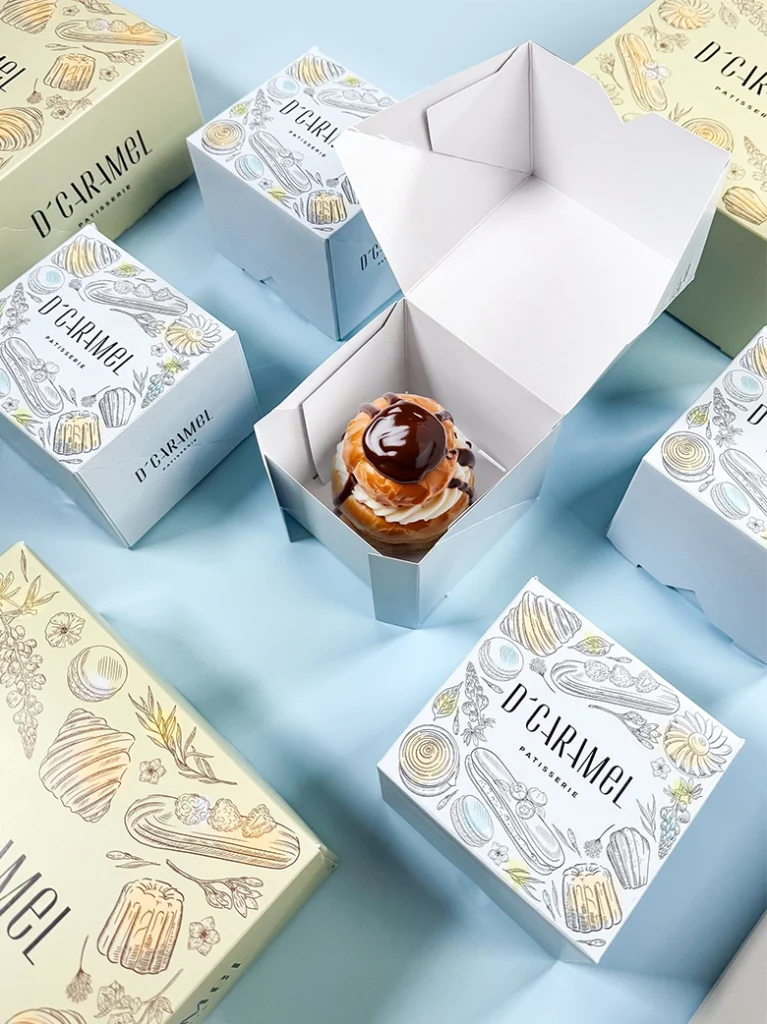
For D’Caramel Patisserie, we had to turn the brand’s vision and values into a coherent identity and packaging. We explored several logo and pattern directions, refined the logo for balance and legibility, and built the packaging around detailed hand-drawn illustrations of pastries and natural elements. They were inspired by the Texas bluebonnet and the brand’s local roots and set in soft pastels of light blue, cream, and pale green. The boxes come in several sizes and look like one family. The project won a Bronze A’ Design Award in Graphics, Illustration and Visual Communication Design and was featured on Packaging of the World.
Crunch Granola is a granola line for the breakfast and snack aisle. The hard part was standing out in a crowded category while keeping four flavors clearly apart. Each flavor got its own bold background color, from mint green to coral red, inside one shared layout and type system. On the front, realistic renders of the granola and its ingredients, a window that shows the product, and simple icons such as “Vegan” and “Ready to Eat” do the work. The back carries the full nutrition panel and preparation information.

What bakery packaging design costs
Costs depend on how many products and formats you have, whether you need a logo, and whether you’re designing printed packaging or labels for stock boxes and bags. Our guide to how much packaging design costs explains the ranges and what drives them.
At SOTDESIGN, our food packaging design services start at $2,500 for the packaging system and the first product. After that, each additional product is about $800, since it reuses the same system, and a logo is about $1,500 if you don’t have one yet. Say you’re launching a new bakery brand and need a logo, a box system, a pastry bag, and a cookie pouch. That comes to about $5,600: $1,500 + $2,500 + 2 × $800. If stickers and labels for stock boxes and bags are all you need, label design starts at $1,500. Every project comes with three concepts and three rounds of revisions, and you’ll get a fixed estimate from us within 1–2 business days after we’ve reviewed your brief.
We work from Albany, New York, and design is all we do. In 10+ years of branding and packaging work, we’ve done 80+ packaging projects for US consumer brands, most of them in food and beverage. We don’t print or manufacture packaging, so the files will work with whichever box supplier or printer you go with.
ready to package your bakery?
boxes, bags, and labels that look like one brand: design only, any supplier
get quoteFAQ
01 What is the best packaging for bakery products?
It depends on the product and how you sell it. Bakery boxes with or without a window suit cakes, pastries, and assortments. Grease-resistant paper bags suit bread and croissants, stand-up pouches suit cookies and granola for retail, and trays with flow wrap suit brownies and bars. Choose the material with your supplier based on grease, moisture, and shelf life, then design a system that covers all of them.
02 How should I package baked goods for sale?
Start with what the product needs to stay fresh and intact, then pick a small set of boxes and bags that covers your range. Brand the fixed parts, use labels or stickers for product names, dates, and allergens, and test the packaging in real conditions, including shipping if you sell online.
03 Do baked goods need a nutrition label?
Packaged baked goods generally need full FDA labeling, including Nutrition Facts, unless an exemption applies. Ready-to-eat items you bake and sell only in your own shop are usually exempt from Nutrition Facts, and very small businesses may qualify too, as long as they make no nutrition claims. Ingredient and allergen labeling can still apply to items you pack ahead of time. See our guide to food label requirements and confirm with your state or local regulator.
04 What should be on a bakery label?
The product name, the net quantity (weight) for packaged goods, the ingredients, the allergen information, and your business name and location. A date isn’t federally required, but customers expect one. Packaged goods sold in stores usually need Nutrition Facts as well. Storage or warming tips are a nice extra.
05 Should bakery boxes have a window?
A window helps when the product looks great and shoppers want to see it, as with cakes, cookies, and bread. It’s less useful for products that don’t look their best in a box or that need protection from light. If you use one, cut it for the products that actually go in that box.
06 How do I make my bakery packaging stand out?
Build one system people recognize, with a logo, a palette, and a pattern or illustration that show up on every box, bag, and label. Give each product line a clear color or mark, show the product honestly, and add seasonal touches so regulars notice something new.
07 How much does bakery packaging design cost?
Packaging design with SOTDESIGN starts at $2,500, covering the system and the first product. Each additional product is about $800, and a logo is about $1,500. Label design for stock boxes and bags starts at $1,500. Most packaging projects we take on fall between $2,500 and $8,000.