Frozen Food Packaging Design: What Changes in the Freezer Aisle
Frozen food packaging has to sell through a glass door. Shoppers see it through glare and sometimes condensation, under cold lighting, often from several feet away, and many decide before they open the door. So frozen packaging needs a bolder front than most grocery products: a large, appetizing photo of the cooked dish, a short product name in high-contrast type, and one or two clear signals such as the protein, the cuisine, or a main claim. It also has to survive the freezer itself, so the materials, inks, and labels must hold up to frost, moisture, and handling at sub-zero temperatures.
The back of a frozen pack carries more than most food packages, too: cooking instructions for several appliances, storage and safety statements, and full nutrition and allergen labeling. And because most frozen brands sell a range, from a few meals to a dozen seafood items, the packaging has to work as a system. Every SKU should stay recognizable, and the whole line should still read as one brand in the freezer.
At SOTDESIGN we’ve designed packaging for two shock-frozen seafood lines, one with more than ten products and one with more than twenty. The notes below come from that work and cover what’s different when the shelf is a freezer.
How the freezer aisle changes design
Most grocery packaging is designed for an open shelf. Frozen packaging goes into a cold, crowded case, often behind glass.
In upright freezers, shoppers see your pack through a glass door that reflects the store lights and sometimes fogs up. Fine details, thin type, and low-contrast colors disappear there, while strong shapes, large type, and clear color blocks hold up. Chest freezers (the open “coffin” cases) work the other way around. Shoppers look down into them, so the top of the box or bag may be the first thing they see. That’s why many frozen brands put the brand and product name on the top panel or on the upper part of a bag.
The light causes its own trouble. Freezer lighting is often cool and bluish, which can make food look gray and warm colors look dull, so check your photography and color choices under similar light before you print. A golden crust that looks perfect on your monitor can turn a sad beige in the case.
Nobody enjoys standing in front of an open freezer, so shoppers decide fast. The pack gets only a moment to say what it is, and that takes a strict hierarchy on the front. Frozen products are also often stacked several deep, and sometimes they end up facing the wrong way. A design that only works from the front loses sales whenever a side or the top is what faces out.
Formats and materials
The format is usually decided with your co-packer and packaging supplier, but each option shapes the design.
| Format | Common for | Design notes |
|---|---|---|
| Folding carton | Meals, pizza, appetizers, desserts | Six panels to design; top and side panels matter in freezers |
| Stand-up or pillow bag | Vegetables, fruit, seafood, snacks | Large front, flexible surface; photography wraps around folds |
| Tray with sleeve or lid film | Ready meals, seafood | Sleeve carries the design; film often shows the product |
| Vacuum pack with label | Fish fillets, meat, premium seafood | Product is the hero; the label carries brand and information |
| Tub or cup | Ice cream, sorbet, frozen yogurt | Round surface; design must read as the container turns |
Whatever the format, the materials have to handle the cold. Frozen packaging needs moisture barriers, coatings that don’t crack, and boards that keep their strength when damp. Labels need cold-temperature adhesives and materials that won’t peel or scuff in the freezer; uncoated paper and ordinary label stock can fail quickly. Your supplier makes these production calls, but tell your designer which materials you’ll use, because they affect color, finish, and how photography reproduces.
Finishes behave differently in a freezer as well. Gloss can boost photography but adds glare behind glass doors. Matte cuts the glare but can make food photos look flat. A lot of frozen brands go matte overall with gloss on the food image. Whichever you pick, ask your printer for a proof on the actual material.
Windows need some thought. A clear window lets shoppers see the product, but in the freezer it can also show ice crystals, frost inside the bag, or broken pieces. If you use one, place it over the part of the product that looks best frozen, and let the printed photo or illustration do the selling.
Front panel photography and hierarchy
On most frozen food packaging, the food photo is the single biggest sales tool. Shoppers can’t see or smell the product, so the photo has to do that work for them.
Show the dish cooked and served: a plated meal, a browned crust, a bowl of soup with steam. Make it big enough to read from a few feet away. On many frozen packs it fills a third or more of the front.
Keep the photo honest. The food in the picture should match what’s in the box, and if you add garnishes or sides that aren’t included, the standard practice is a “serving suggestion” note near the image. Shoppers who feel misled by a photo rarely buy again.
After the photo, the shopper needs the product name and one or two facts that decide the purchase. That could be the protein (“wild-caught salmon”), the cuisine (“Thai green curry”), the convenience (“ready in 5 minutes”), or a claim (“20 g protein,” “gluten free”). Save long ingredient stories, brand history, and secondary claims for the back. On the front they crowd the panel and slow the decision down.
Photography isn’t the only route. For seafood, ingredients, and premium lines, strong illustration can stand out precisely because the rest of the freezer is full of food photos. It works best when it’s bold and simple.
Raw products need extra care, because some of them look cooked. Breaded stuffed chicken is the classic case. USDA’s Food Safety and Inspection Service has issued public health alerts about frozen raw breaded stuffed chicken that “may appear to be ready-to-eat” but needs to be fully cooked. Those labels did say the product was uncooked. Still, some people who got sick had used a microwave or air fryer, or cooked it for less time than the label said. So put “raw” or “uncooked” and a clear cooking instruction on the front as well as the back, close to the product name. Your regulatory advisor should confirm the exact wording.
Cooking instructions and the back panel
Frozen packaging carries more practical information than most food packaging, and people read it with a cold box in one hand.
Many frozen products need directions for more than one appliance: oven, microwave, stovetop, and more and more often an air fryer. Give each method its own block with an icon, the temperature, the time, and any step like stirring or resting. Nobody should have to untangle four methods in one paragraph. If a method hasn’t been tested, leave it off. Your product team or co-packer validates and writes the instructions, and the designer lays them out but doesn’t write them. With raw products, a method that’s easy to misread isn’t just a ruined dinner. It’s a food safety problem.
Storage comes next. Put “Keep frozen” where shoppers and store staff will see it, usually on the front or top. For meat and poultry products under USDA, a handling statement such as “Keep Frozen” is required on the principal display panel, and raw or partially cooked meat and poultry also need USDA’s safe handling instructions.
Most frozen foods need a full Nutrition Facts panel, an ingredient list, and an allergen declaration. Under FDA rules, a package that holds between two and three times the reference amount for that food (roughly two to three servings) generally needs a dual-column panel showing nutrition per serving and per package; larger packages can use one voluntarily. A dual-column panel takes noticeably more room, so find out early whether you need one.
Then leave space for codes. Lot codes and best-by dates are usually printed or stamped at the plant, so reserve a clear area for them where they won’t land on top of the design. The barcode belongs on a flat panel, away from folds, seals, and areas that wrinkle or frost over, so it scans at the register.
Required labeling and who regulates it
Frozen food can fall under different US agencies depending on what’s inside, and that affects the label.
- Most frozen foods follow FDA labeling rules: statement of identity, net quantity, ingredients, allergens, Nutrition Facts, and the name and address of the manufacturer, packer, or distributor. Start with the FDA’s labeling and nutrition guidance. For a plain-language walkthrough, see our guide to food label requirements.
- Products made with meat or poultry above set thresholds (generally more than 3% raw or at least 2% cooked meat or poultry, based on the recipe) fall under USDA’s Food Safety and Inspection Service. Its labeling requirements include the USDA mark of inspection with the establishment number, a handling statement such as “Keep Frozen,” and, for raw or partially cooked meat and poultry, safe handling instructions. Catfish and related fish of the order Siluriformes are also inspected by FSIS, not FDA.
- Unprocessed fish and shellfish, such as frozen fillets or raw shrimp, generally need country of origin and method of production (wild-caught or farm-raised) at retail under USDA’s country of origin labeling rules. Fish that has been cooked, smoked, or cured, or combined with other ingredients, as in a breaded fillet or a seafood meal, is usually treated as a processed item and exempt. The rules apply to the retailer, but your package is usually the easiest way to pass the information along.
- Seafood names should follow FDA’s Seafood List, which gives the acceptable market name for each species. A local or invented name can make the label misleading. For glazed products, FDA’s position is that the net weight of frozen seafood may not include the ice glaze, so the weight on the pack is the seafood alone.
- Ice cream is a standardized name. Under FDA’s standard it needs at least 10% milkfat. Products that fall short use another name, often “frozen dairy dessert,” and that changes the front panel.
Which rules apply depends on your exact product, so have your regulatory advisor or co-packer confirm the requirements and approve the final copy. Our part as designers is fitting all of it legibly, in the required formats, without burying the brand.
launching a frozen line?
send us your SKU list and formats: fixed estimate in 1–2 business days
get quoteBuilding a system for a frozen range
Most frozen brands sell a range: several meals, a set of vegetables, a seafood line with a dozen species. A consistent system turns those packs into a block of your brand in the freezer, and a block is easier to find than a single box.
Start by fixing the frame. The logo position, the background color or texture, the typography, and the layout of the front stay the same on every SKU. Then choose one main signal to tell products apart, such as the photo of each dish, an illustration of each ingredient, or a color for each flavor or product type.
Design with the full SKU list in front of you, including products you plan to add. Then test the system on the product with the longest name and the most back-panel copy.
Two seafood lines we designed show how this works.
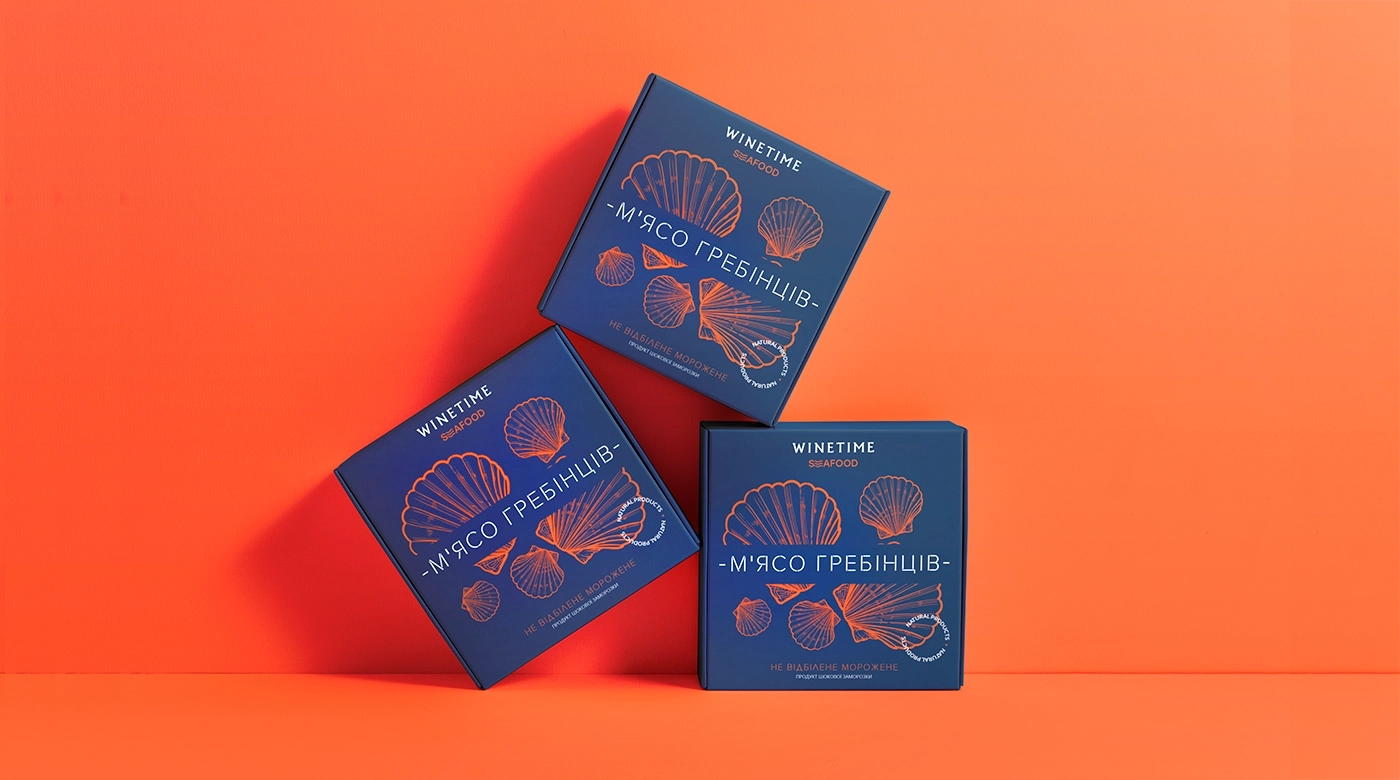
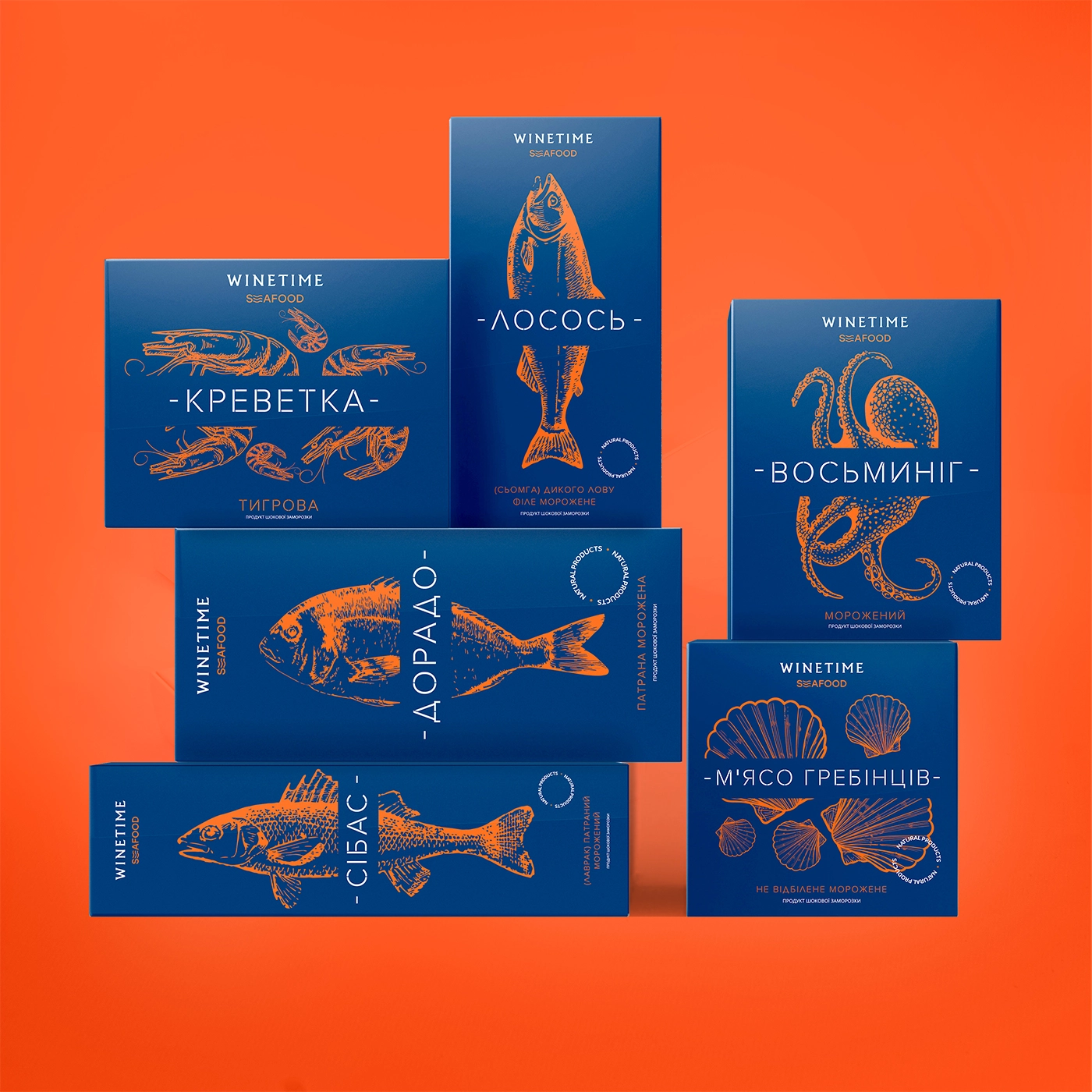
For WineTime Seafood, a premium line of shock-frozen fish and seafood with more than ten items, including wild dorado, salmon, European bass, scallops, octopus, and tiger shrimp, the client wanted one consistent system that would unite the line and still keep each SKU recognizable on retail shelves. Every pack sits on a deep blue base that evokes the sea, with detailed hand-drawn line illustrations of each item in the brand’s signature orange and crisp white sans-serif type. On the shelf, the shared blue holds the line together and the drawing of each item tells the products apart. The same logic carries over to supporting pieces such as aprons, gift bags, and printed materials.
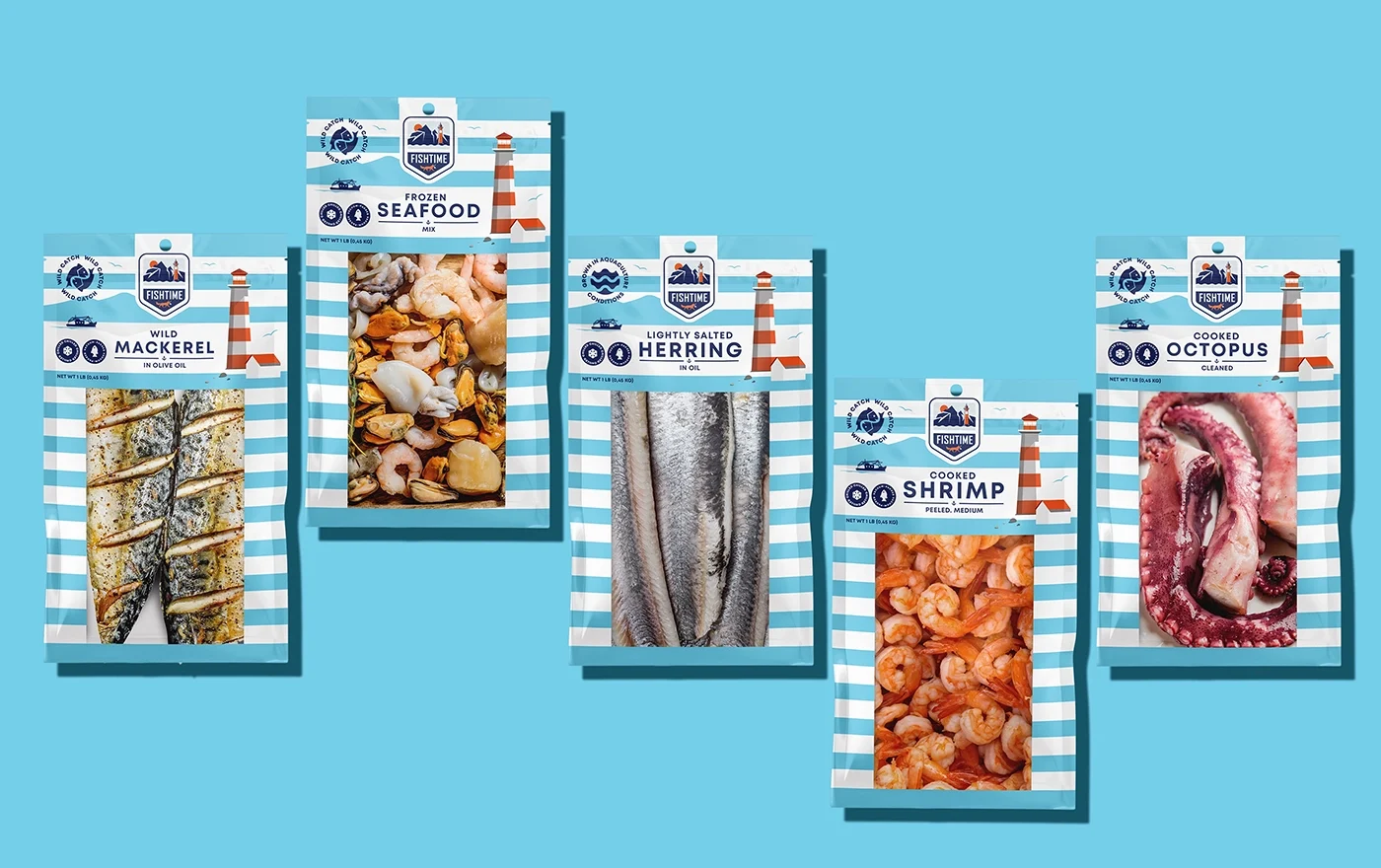
For Fishtime, a new line of more than twenty shock-frozen fish and seafood products, the packaging had to communicate trust and freshness at a glance. The logo and packaging use a flat illustration of a lighthouse against calm water and distant mountains, inspired by Norwegian fjords. We applied it consistently across the whole line in cool tones so the range stands out on retail chain shelves. The project also included a brand book covering logo use, palettes, typeface, and tone of voice, so new products follow the same rules.
Frozen food packaging checklist
Before design
- Formats and materials confirmed with your co-packer or supplier, with dielines.
- Full SKU list, including planned products.
- Regulatory owner named, and which agency’s rules apply.
- Cooking instructions validated for every appliance you’ll list.
- Photography plan: new shoot, existing photos, or illustration.
Front and top panels
- Product readable through a glass door from a few feet away.
- Food photo or illustration large and appetizing; “serving suggestion” where needed.
- Product name and the one or two deciding facts easy to find.
- Raw products clearly marked as raw, with a cooking instruction near the name.
- Brand and product name visible on the top panel for chest freezers.
Back panel
- Cooking instructions with icons, one method per block.
- Storage statement and any required handling and safe handling statements.
- Nutrition Facts (dual-column if required), ingredients, allergens, net quantity, and company information.
- For seafood: acceptable market name, country of origin and method of production where required, and net weight without glaze.
- Space reserved for lot codes and dates; barcode on a flat panel.
Production
- Materials, inks, and labels rated for freezer conditions.
- Printed proofs checked under cool lighting.
- Finishes chosen with glare in mind.
Common frozen packaging mistakes
- Designing for the open shelf. Thin type and subtle colors that look elegant on a screen vanish behind a fogged-up door.
- A photo that’s too small. In the freezer aisle, the food image usually needs to be bigger than designers expect.
- Overpromising in the photo. Garnishes and portions the box doesn’t deliver lead to complaints and lost repeat purchases.
- Forgetting the top and sides. Products stacked or lying flat show the panels you didn’t design.
- Cramped cooking instructions. Tiny text with four appliances crammed together means ruined meals and complaints, and with raw products, undercooked food.
- Ordinary labels in the freezer. Labels that peel or scuff make a premium product look cheap.
What frozen food packaging design costs
Costs depend on the number of SKUs, whether you need a brand identity, the format, and whether you need new photography or illustration. A single frozen meal costs far less than a twenty-item seafood line with a new logo. Our guide to how much packaging design costs lays out the ranges and the factors behind them. When you’re preparing a project, the guide on how to write a packaging design brief includes a template to copy.
Our own packaging design starts at $2,500. That pays for building the packaging system and the first SKU. Every SKU you add costs about $800 because it reuses that system, and a new logo is about $1,500. A frozen brand that needs a logo and packaging for three meals would pay about $5,600 ($1,500 + $2,500 + 2 × $800). Lines of ten or more SKUs get a volume discount, which typically puts a ten-SKU packaging line around $8,000, and most of our packaging projects come in between $2,500 and $8,000. Each project includes three concepts and three rounds of revisions. Send us your brief, and after we’ve reviewed it you’ll have a fixed estimate within 1–2 business days.
SOTDESIGN works out of Albany, New York, and has spent more than 10 years designing packaging. We only design: printing and manufacturing stay with your partners, and our files are set up for whichever co-packer, packaging supplier, or printer you choose. If you’re planning a freezer line, take a look at our food packaging design services.
ready to design for the freezer aisle?
packaging systems for frozen meals, seafood, and more: design only, any printer
get quoteFAQ
01 What makes frozen food packaging different from other food packaging?
Three things: how it’s seen, the cold, and how much the pack has to say. Shoppers see it through glass or from above in chest freezers, under cool lighting, and decide quickly. The pack also has to survive frost and moisture, and the back usually carries cooking instructions for several appliances on top of the nutrition and allergen labeling.
02 What are the best packaging options for frozen food?
Common options are folding cartons for meals and pizza, stand-up or pillow bags for vegetables, fruit, and seafood, trays with sleeves or lid film for ready meals, vacuum packs with labels for fish and meat, and tubs for ice cream. The right choice depends on the product, your co-packer, and your shelf life needs.
03 What is the best packaging material for frozen food?
Look for materials with a good moisture barrier that stay strong and flexible in the cold, such as coated paperboard and freezer-grade plastic films. Labels need cold-temperature adhesives. We design the graphics, and your packaging supplier specifies the material for your product and process.
04 Should frozen food packaging use photos or illustrations?
Most frozen products use photography of the cooked dish, because shoppers can’t see the food itself. Illustration works well for ingredients, seafood, and premium lines, and it can stand out in a freezer full of photos. Either way, the image has to be bold and simple enough to read from a few feet away.
05 How do I make my frozen food stand out in the freezer?
Use high contrast, a large food image or a bold illustration, and a short product name. Design the top panel as well as the front. If you sell a range, build a consistent system across it so your products form a visible block of the brand.
06 What has to be on a frozen food label?
Usually a statement of identity, net quantity, ingredients, allergens, Nutrition Facts, and the name and address of the company. Meat and poultry products above USDA’s thresholds also need the mark of inspection, a handling statement such as “Keep Frozen,” and, if raw or partially cooked, safe handling instructions. Unprocessed fish and shellfish typically need country of origin and method of production. Cooking directions aren’t always legally required, but on frozen food shoppers expect them. Have a regulatory advisor confirm what applies to your product.