Chocolate Packaging Design: A Guide for Chocolate Makers and Confectionery Brands
Good chocolate packaging protects a product that melts, picks up odors, and blooms when the temperature swings, and it tells shoppers what kind of chocolate they’re holding before they read a word. On a bar, the front usually needs the brand, the product name (such as “dark chocolate” or “milk chocolate,” often with the cacao percentage), the flavor or inclusions, and the net weight. The back carries the story, tasting notes, ingredients, and allergens. With bonbons and truffles, the box is part of the gift, so the opening moment and a flavor guide matter as much as the lid.
Chocolate packaging differs from other food packaging in two ways. First, the names are regulated: in the US, “milk chocolate,” “white chocolate,” and “semisweet” or “bittersweet chocolate” have federal standards, and a product that replaces cocoa butter with other fats can’t simply be called chocolate. Second, much of chocolate is bought as a gift or for a season, so plan a flexible system from day one that handles Valentine’s, holidays, and limited editions without a redesign each time.
At SOTDESIGN, packaging design starts at $2,500 for the packaging system and the first SKU, with about $800 for each additional flavor or box. This guide covers formats, bar and box design, the naming rules, bloom and shipping, allergens, gift and seasonal lines, and the Dubai chocolate trend, and it ends with two of our own chocolate projects.
Chocolate packaging formats
| Format | Common for | Design notes |
|---|---|---|
| Foil inner wrap with a paper sleeve or wrapper | Craft and premium bars | The sleeve carries the design; the foil adds a premium unwrap |
| Flow-wrapped bar | Mass-market and snack bars | Small surface, printed film; flavor and brand only on the front |
| Folding carton for bars | Premium and gift bars | More room and a sturdier feel; works well with an inner wrap |
| Bonbon or truffle box with insert | Chocolatiers, gift collections | The lid carries the brand; the insert and a flavor guide make the gift |
| Rigid gift box | Luxury and corporate gifting | Higher cost; often kept and reused, so the brand stays in sight |
| Stand-up pouch | Chocolate-covered nuts and fruit, minis, baking chips | Resealable, good for grocery and online |
| Tins and shaped boxes | Holiday, Valentine’s, keepsakes | Strong gift appeal; plan for tooling costs |
Whatever the format, chocolate needs protection from light, moisture, heat, and odors. Your supplier will choose between foil, coated papers, and barrier films, but that choice changes the look as much as the protection. Foil reads as premium, uncoated paper as craft, and glossy film as mass-market, so talk about the look you want before the material is locked in.
Designing a chocolate bar
A bar is small, and shoppers often pick from a long row of similar sizes. The front has room for about four things:
- Brand. Clear, but it doesn’t have to be the biggest element.
- Product name and cacao percentage. “Milk chocolate,” “dark chocolate 72%,” “white chocolate.” Many buyers shop by percentage, so make it easy to find.
- Flavor or inclusion. “Sea salt almond,” “raspberry,” “toffee crunch.” This is usually why someone picks this bar over the next one.
- Net weight, which belongs on the front.
The back is where chocolate brands tell their story: where the beans come from, who made the bar, tasting notes, pairing ideas. Craft buyers do read it. Keep it to a few short paragraphs and leave room for the ingredients and allergen statement.
A chocolate line grows by flavor and by percentage, so it pays to set up a system for the whole range early. Fix the layout, typography, and brand position, and change one thing per bar. Usually that’s color, sometimes an illustration or a pattern. Plenty of brands also give their dark, milk, and white bars different base colors so shoppers can find the type they want before they look at flavor.
Don’t skip the unwrap, either. A printed inside of the sleeve, a message under the fold, or a foil wrap with a pattern costs little and makes a bar feel special.
Designing boxes for bonbons and truffles
In a chocolate shop, the box often sells more than the window display does.
Start with the lid. It needs a strong brand mark, a pattern or illustration, and the collection name, and many premium brands keep it quiet and let the opening do the work. The inside deserves just as much thought: a tray or insert that holds each piece in place, a printed inner lid, and a flavor guide that tells people which piece is which. Customers keep going back to that guide as they work through the box.
Plan your sizes as a family. A 4-piece, a 9- or 12-piece, and a 24-piece box in the same design language look like a collection on the counter, and they make upselling easy. Make the box easy to customize, too. A belly band, sticker, or ribbon can turn one standard box into a Valentine’s box, a corporate gift, or a thank-you box without new printing plates.
What “chocolate” means on a US label
Many new brands don’t realize the FDA has standards of identity for cacao products (21 CFR part 163), and that the name on the front has to match the standard the product meets.
| Name on the label | What the standard requires (simplified) |
|---|---|
| Sweet chocolate | At least 15% chocolate liquor |
| Semisweet or bittersweet chocolate | At least 35% chocolate liquor |
| Milk chocolate | At least 10% chocolate liquor, 3.39% milkfat, and 12% total milk solids |
| White chocolate | At least 20% cocoa butter, 14% total milk solids, and 3.5% milkfat, with no more than 55% sweeteners |
The standards have a few practical consequences for the label.
- There’s no separate federal standard for “dark chocolate.” Most dark chocolate meets the sweet or semisweet/bittersweet standard. Putting “dark chocolate” on the front is common, but the product still has to fit one of the standards for the word “chocolate.”
- Swapping cocoa butter for other fats changes the name. The standards allow only cocoa butter and dairy fats; other vegetable fats aren’t permitted. Products made with them fall under separate coating standards (21 CFR 163.150 to 163.155) or need a different name, which is why some well-known candies are labeled “chocolate candy” rather than “milk chocolate.” The practice isn’t new, but it drew more attention when record cocoa prices in 2024 pushed some makers toward cheaper fats.
- Products flavored only with cocoa powder are covered by a separate FDA compliance policy: when shoppers would expect real chocolate, the label has to say “chocolate flavored” (FDA CPG Sec. 515.800).
- The FDA doesn’t define the cacao percentage. “70% cacao” usually means the share of all ingredients that come from the cocoa bean, including chocolate liquor, cocoa butter, and cocoa powder. It still has to be accurate and not misleading.
So settle the exact product name, based on your recipe and with your regulatory reviewer, before anyone designs the front. If “milk chocolate” turns into “chocolate candy” at proof stage, the hierarchy of the whole pack has to change. The rest of the label, from net weight to the ingredient panel, follows the general FDA rules we cover in our guide to food label requirements.
Bloom, heat, and shipping
Chocolate can change how it looks while it sits on the shelf. Bloom is the whitish film that appears when fat or sugar rises to the surface, usually after temperature swings or humidity. Bloomed chocolate is safe to eat (CFIA: chocolate bloom), but it looks old, and a premium bar that arrives gray will probably cost you that customer.
Packaging can help in a few ways:
- Use a barrier inner wrap and an outer pack that limits light and moisture. Your supplier will advise on materials.
- Print storage guidance on the pack: keep in a cool, dry place, away from heat and direct sun. That one short line saves complaints.
- If you sell online, plan for summer. Design the mailer and inserts with insulated liners and cold packs in mind, and consider a seasonal note on the website and on the box about warm-weather shipping.
- Be careful with windows. Clear windows on chocolate boxes show off the pieces, but they also let in light and show any bloom or scuffing. Use them for products that ship and sell quickly.
Allergens and “may contain”
Chocolate products often involve several of the nine major food allergens: milk, tree nuts, peanuts, soy (lecithin is common), and wheat in cookies, wafers, and crunchy inclusions. Packaged foods must declare each of the nine major allergens they contain, in the ingredient list or in a separate “Contains” statement (FDA: food allergies).
Be especially careful with dark chocolate. Many dark chocolates are made on the same lines as milk chocolate, and FDA testing has found milk in dark chocolate bars that didn’t declare it. “May contain milk” statements are voluntary, but they must be truthful and can’t replace good manufacturing practices. On the pack, keep the allergen information easy to find and close to the ingredients, and don’t give a bar that may contain milk a “dairy-free” look.
designing a chocolate line?
bars, bonbon boxes, and seasonal collections in one system: fixed estimate in 1–2 business days
get quoteGift, seasonal, and limited editions
Much of chocolate is bought as a gift, and a lot of it around a few dates: Valentine’s Day, Easter, Halloween, and the winter holidays. Build the packaging system with those dates in mind.
Keep the core range stable and add seasonal elements on top, such as a sleeve, a sticker, a ribbon, or a special illustration for the season. Give collections names and stories, because a themed box sells as a gift idea in its own right. Boxes worth keeping help too. Collectible art, a box that works as a keepsake, or a series that changes each season gives people a reason to come back.
If a gift idea involves a toy or trinket, check the toy rule. Federal law doesn’t allow a non-food object to be embedded in the candy itself, with narrow exceptions (21 U.S.C. 342(d)). The usual solution is to pack the item in a separate compartment.
The Dubai chocolate trend and what it means for packaging
“Dubai chocolate” is a thick chocolate bar filled with pistachio cream and crunchy shredded pastry (kataifi). It started with a chocolatier in Dubai, went viral on social media in late 2023 and through 2024, and by 2025 was everywhere, from small chocolate shops to national brands and grocery chains in the US. The demand even put pressure on pistachio supply.
For chocolate brands, it’s a useful case study in packaging for a trend.
Describe the product, and be careful with the place name. Many brands call theirs “Dubai-style” and show the cross-section, the green filling, and the crunch. In Germany, early court rulings split, and in mid-2025 an appeals court in Cologne held that “Dubai chocolate” tells shoppers the bar comes from Dubai. If you lean on a place name, check the wording with your reviewer.
The filling is the whole appeal, so show it. A cut-bar photo or illustration on the pack explains it instantly.
Move fast, because a trend can peak in months. A sleeve or a sticker on your existing bar system gets you to the shelf quicker than a new structure. And think about what happens when the trend cools. If the product stays, fold it into the core range with the same system; if it fades, you haven’t rebuilt your packaging for it.
Signaling the price tier
Chocolate prices span a huge range, and shoppers read the tier off the pack.
- Mass-market bars use bright printed film, big brand marks, and bold flavor cues.
- Craft bars lean on uncoated papers, origin and maker stories, clean typography, and the cacao percentage.
- Luxury and gifting use rigid boxes, foil and embossing, restrained color, and an unboxing experience.
Shoppers get suspicious when the pack and the price don’t match, like a $12 single-origin bar in a pack that looks like a $2 candy bar, or the reverse. Decide your tier first, then design for it.
Common chocolate packaging mistakes
- The product name doesn’t match the standard. “Milk chocolate” on a product made with other fats is a labeling problem, not a design detail.
- Each bar is designed on its own, and a row of unrelated wrappers doesn’t read as a brand.
- There’s no flavor guide in the box, so people don’t know what they’re eating and the box loses half its charm.
- Summer gets ignored. Packaging that doesn’t account for heat leads to bloom, melted pieces, and refunds.
- Every holiday gets a redesign. Without a flexible system, each one becomes a new project and a new print run.
Two chocolate projects from our work
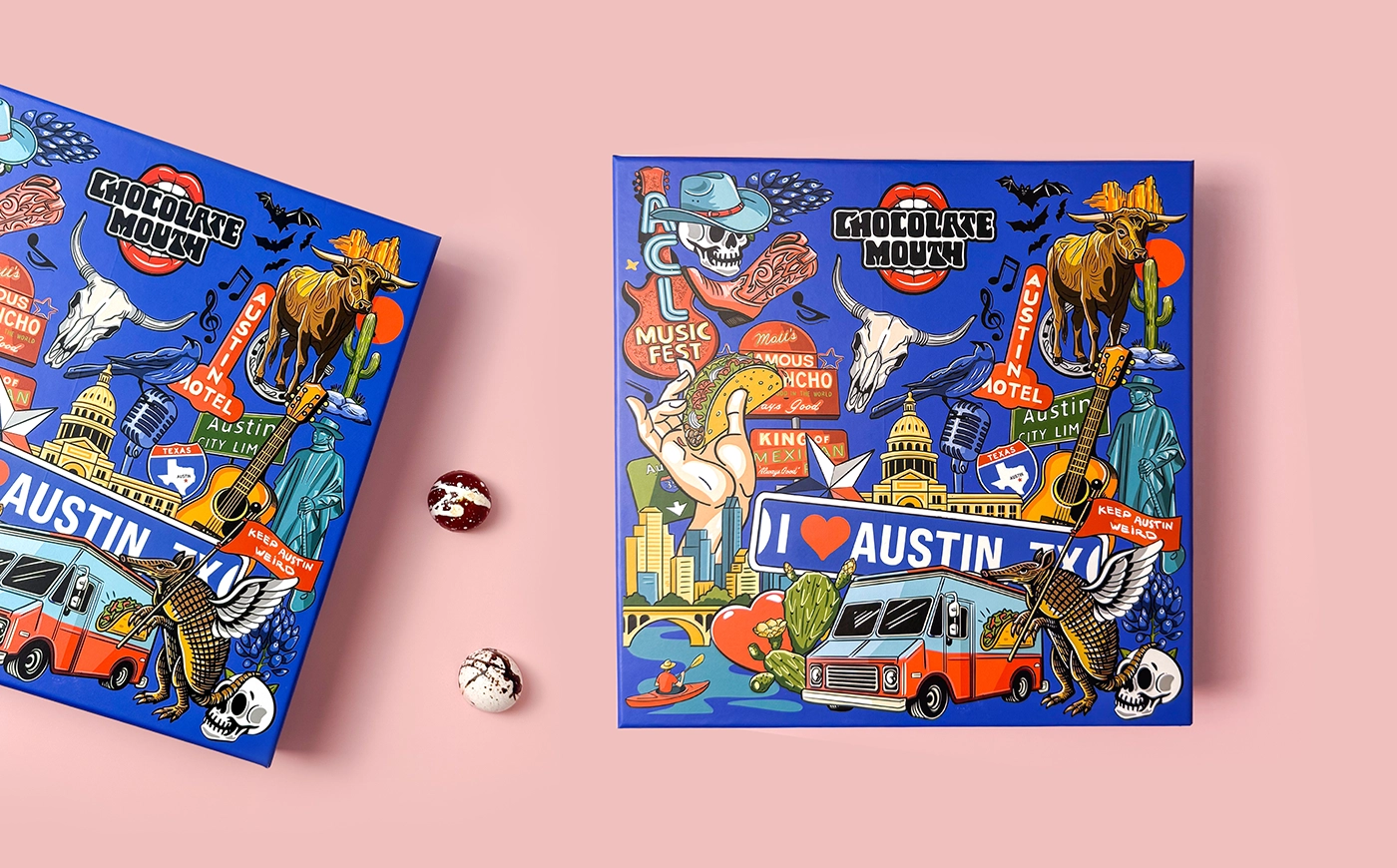
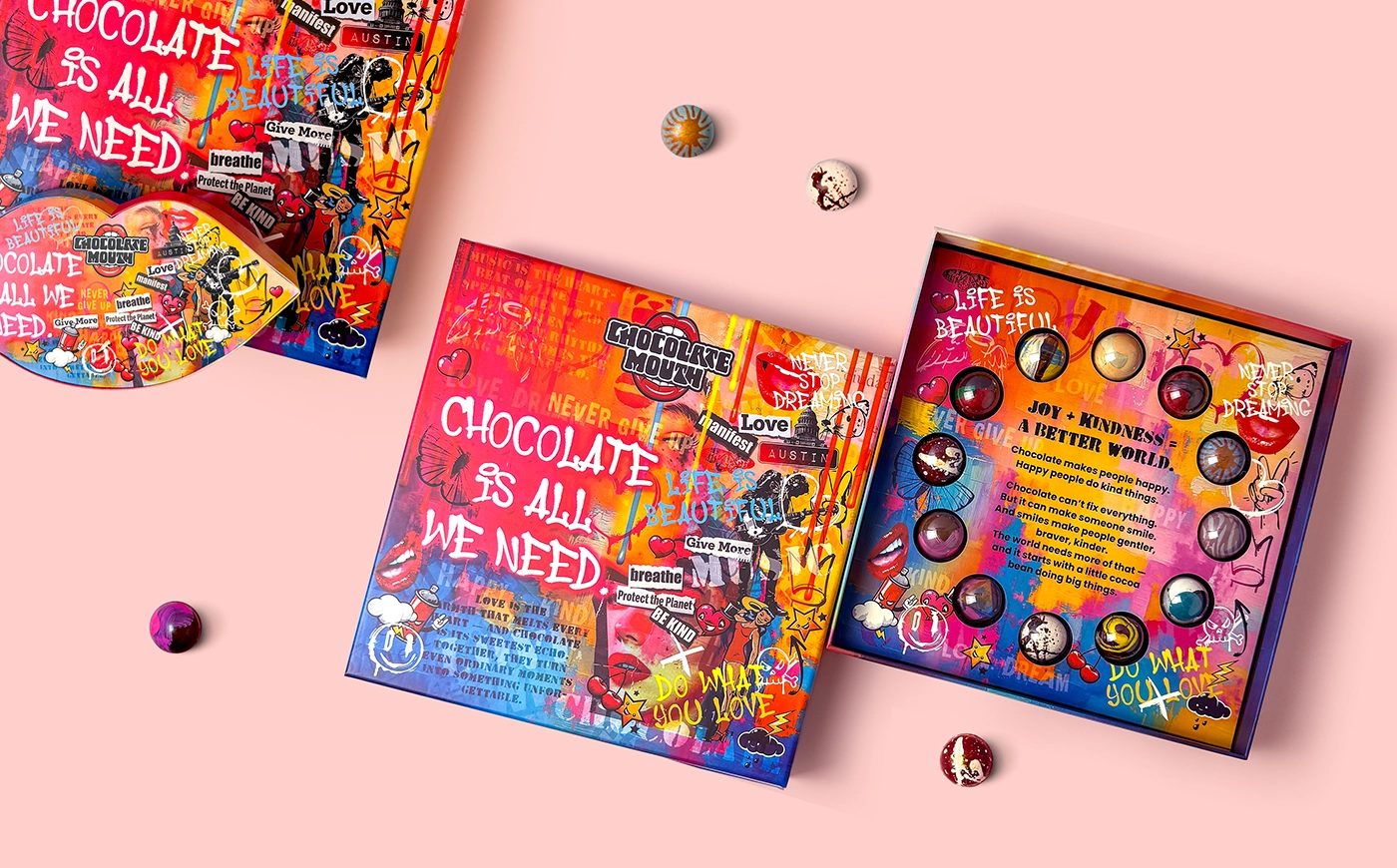
Chocolate Mouth is an artisan chocolate company in Austin, Texas, known for handmade bonbons and gift boxes. The brief was to step away from traditional, predictable chocolate packaging and show personality, humor, and Austin’s offbeat culture. We designed a logo with bold lettering inside red lips and a library of custom, tattoo-style illustrations: skeletons, cupids, cowgirls, a longhorn, cactus, and Austin landmarks. The themed boxes, from a Valentine’s box to “I Love Austin,” work like mini art posters, so each one is collectible, and the identity stretches easily to new themes and seasonal drops.
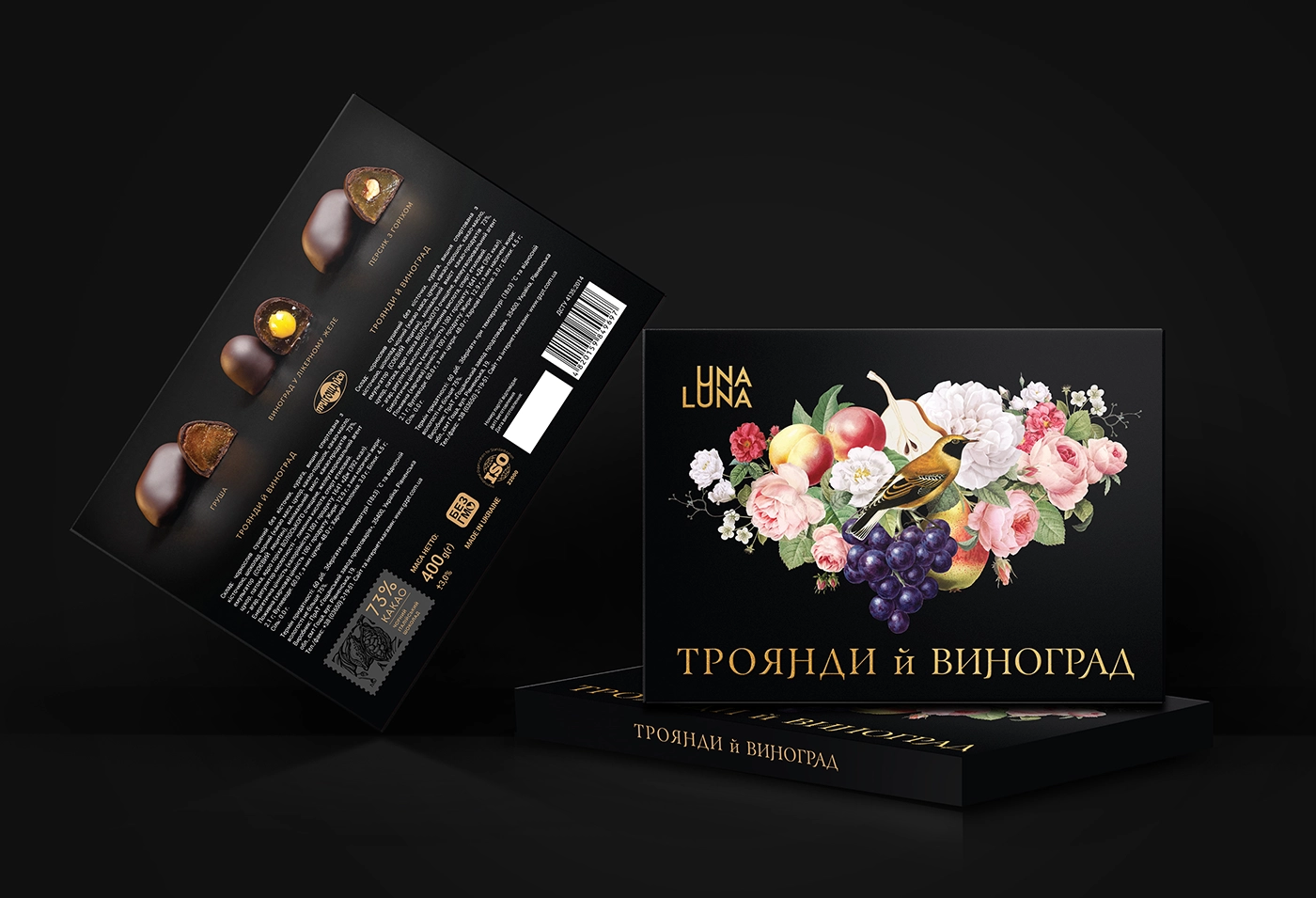
Una Luna is a luxury chocolate brand made with Italian dark chocolate and natural ingredients. Our task was to turn two collections, Roses and Grapes and Cherry Garden, both inspired by Ukrainian poetry, into packaging that tells a story and still keeps the brand clear. Each collection uses a collage of fruit, floral, and natural motifs on a deep black background, with small gold lettering for a premium feel. It won an A’ Design Award in the Packaging Design category.
What chocolate packaging design costs
Costs depend on the number of bars, boxes, and seasonal editions, whether you need a logo, and whether the work includes illustration. The ranges, and what pushes a project up or down, are covered in our guide to how much packaging design costs.
Our food packaging design services begin at $2,500, and that price includes the packaging system and your first SKU. Each additional bar flavor or box is about $800 because the system is already built, and a logo costs about $1,500 if you need one. A new chocolatier who needs a logo, a bonbon box, and three bar flavors would pay about $6,400 ($1,500 + $2,500 + 3 × $800). We give lines of ten SKUs or more a volume discount, so a ten-SKU line usually comes in around $8,000. Every project includes three concepts and three revision rounds, and we send a fixed estimate within 1–2 business days of receiving your brief.
We’re a design-only studio in Albany, New York, with 10+ years in branding and packaging and 80+ completed packaging projects for consumer brands, mostly food and beverage. We don’t print or manufacture packaging, so your wrapper and box files will work with any printer or box maker you choose.
ready to design your chocolate packaging?
bars, boxes, and seasonal collections: design only, any printer
get quoteFAQ
01 What makes good chocolate packaging?
It protects the chocolate from heat, light, moisture, and odors, tells shoppers the type and flavor at a glance, and matches the price tier. With boxes, the opening and a flavor guide matter as much as the lid. A system that takes new flavors and seasonal editions without a redesign keeps the brand consistent.
02 What should be on a chocolate bar wrapper?
On the front: the brand, the product name (often with the cacao percentage), the flavor or inclusions, and the net weight. On the back: the ingredients, allergen information, the name and address of the company, and usually the story, origin, and tasting notes. Nutrition Facts are required unless an exemption applies.
03 Can I call my product chocolate if it uses palm oil or other fats?
In the US, the standards for sweet, milk, and white chocolate allow only cocoa butter and dairy fats. Products made with other vegetable fats fall under separate vegetable fat coating standards or need a different name, such as “chocolate candy.” If cocoa powder is the only chocolate ingredient, the FDA expects “chocolate flavored.” Confirm the exact name with a regulatory reviewer.
04 Is “dark chocolate” a regulated term?
There’s no separate federal standard for “dark chocolate.” Most dark chocolate meets the standard for sweet chocolate (at least 15% chocolate liquor) or for semisweet or bittersweet chocolate (at least 35%). The FDA doesn’t define the cacao percentage on the front, but it must be accurate.
05 How do I keep chocolate from blooming in the package?
Use a good barrier inner wrap, keep products away from temperature swings and humidity in storage and shipping, and print storage guidance on the pack. Bloomed chocolate is safe to eat, but it makes a premium bar look old.
06 What is the best packaging for chocolate gifts?
A rigid or sturdy folding box with an insert that holds each piece, a printed inner lid or flavor guide, and an outer design worth keeping. Add a belly band or sticker and one box can serve several occasions.
07 How much does chocolate packaging design cost?
We charge from $2,500 for packaging design, which includes the system plus the first SKU. Each extra bar or box is about $800, a logo is about $1,500, and most of our packaging projects land somewhere between $2,500 and $8,000.