Candy Packaging Design: Ideas and What Works on the Shelf
Candy is an impulse buy, so the package has about one glance to do its job. In that moment it has to show what kind of candy is inside (sour, chewy, fruity, crunchy), make the flavor obvious through color, and fit the place where candy actually sells: a checkout rack, a peg hook, the candy aisle, a gift shop shelf, or a thumbnail on Amazon. The format follows the candy. Gummies usually go in stand-up pouches or peg bags, hard candy and mints in tins, rolls, or twist wraps, lollipops in printed wrappers with a counter display box, and assortments in gift boxes with an insert.
Cute graphics are only part of the job. Candy packaging sells when there’s a system behind it, with a flavor color code a seven-year-old can read and room for seasonal editions without a redesign. The label also has to meet federal food rules, including new federal rules on food dyes.
At SOTDESIGN, candy and confectionery packaging design starts at $2,500, enough to build the packaging system and finish your first SKU. Each added flavor or size runs about $800. This guide walks through formats by candy type, design ideas that hold up on a crowded shelf, label rules specific to candy, seasonal planning, materials, and three of our confectionery projects.
Candy packaging formats by type
| Candy | Common formats | What the design has to do |
|---|---|---|
| Gummies and chewy candy | Stand-up pouch, peg bag, theater box | Show the texture and flavor; reseal for share sizes |
| Hard candy and mints | Tin, roll, twist wrap, jar | Read in one glance on a small surface |
| Lollipops | Printed wrapper plus a counter display box | Work as a pair: the wrapper sells one, the box sells the set |
| Sour candy | Pouch, peg bag, tube | Signal how sour it is before anyone reads the copy |
| Chewing gum | Slim packs, bottles, blister packs | Let flavor color do the work on a tiny front |
| Boxed assortments | Folding or rigid box with an insert | Feel like a gift and explain what each piece is |
| Seasonal and novelty | Shaped boxes, tins, bags of fun-size pieces | Swap the theme while the brand stays put |
If your line is mostly chocolate bars and bonbons, our chocolate packaging guide covers bar wrappers, truffle boxes, and the federal rules on what can be called chocolate. This article covers the rest of the candy aisle.
Where your candy sells shapes the design
The same gummy bear needs a different package at a gas station register than in a gift shop. Before you brief a designer, list every place the candy will be sold, then design for the hardest one first.
At the checkout, candy sits at arm’s length in a rack or a counter display. Shoppers decide in a second or two, often while doing something else, so the front should show brand, flavor, and texture and nothing else. The display box that holds 12 or 24 units counts as packaging too. It is the first thing people see, and a plain brown shipper wastes that space.
Peg hooks are common for bags of gummies and hard candy in grocery and drug stores. The bag hangs from a header, so the top third of the front is what shoppers see at eye level. Put the brand and flavor there, not at the bottom where the bag folds and crinkles.
In the candy aisle of a grocery store, your package sits in a row of competitors with the same format. Color blocking by flavor helps your line read as one block on the shelf, which makes it easier to find and harder to ignore. Chips and other snacks face the same kind of shelf, which we cover in our guide to snack packaging design.
Specialty candy stores and gift shops sell on charm and story. Here a box with a nice opening, a printed insert, or a tin someone will keep can justify a higher price.
Online, the package becomes a thumbnail about the size of a postage stamp. Test the front at that size. If the flavor name disappears, make it bigger or move the photography out of the way.
Design ideas that work on the candy shelf
Let color carry the flavor
Shoppers look for their flavor before they look for anything else. Give each flavor a color that matches what people expect (red for cherry or strawberry, green for apple or lime, yellow for lemon, purple for grape) and keep that code across every format you make. When a cherry pouch and a cherry lollipop wrapper use the same red, the line looks bigger and more organized on the shelf.
Show the candy, but decide how
A window lets people see the real gummies, and for many candy types that sells better than any illustration. Windows have costs, though. They take space from the design, they show broken or stuck pieces, and light can fade colors in clear packs over time. Photography of the candy is an alternative that stays consistent from bag to bag. Illustration works well for kids’ candy and for brands built around a character.
Make the texture visible
Sour, fizzy, chewy, and crunchy are the words people use when they choose candy. Typography can do some of that work: jagged or shaking letters for sour, soft rounded shapes for chewy. A sugar-coated close-up or a single bitten gummy shows texture faster than copy can.
Give the brand a character
A mascot gives kids something to recognize and gives the brand a face for social media, displays, and seasonal editions. Keep the character simple enough to work at the size of a gum pack and flexible enough to wear a Halloween costume in October.
Speak to the adult who pays
Kids pick the bag, but a parent reads the back and pays for it. Claims like “no artificial dyes,” “gluten-free,” or “made with real fruit juice” matter to many parents. Give them a consistent place on the pack, usually a small band near the bottom of the front, so they don’t fight with the flavor name.
Make the flavor name the biggest word after the brand
It sounds obvious, yet many candy packs bury the flavor in a small script under a large illustration. Shoppers scan for “Watermelon” or “Sour Blue Raspberry.” Make it easy for them.
Gummy packaging design
Gummies take up a lot of the candy aisle, and most of them come in stand-up pouches. A pouch gives you a large front, a gusset that lets it stand on a shelf, and a zipper for share sizes. Peg bags with a header cost less and are common for mid-size bags.
A few things to settle early:
- Window or no window. A window shows real gummies but takes design space; a full print with photography looks more consistent.
- Reseal. A zipper matters for share sizes and family sizes. Show that the bag reseals, because shoppers look for it.
- Heat and sticking. Gummies can soften and clump in a hot truck or a sunny window, so a pack that survives shipping matters as much as the graphics.
- Diet and ingredient claims. Gelatin-based gummies can’t be called vegan; pectin-based gummies often can. Kosher and halal symbols require certification from the agency that owns the mark.
Gummies sold as vitamins or supplements are a separate category. They follow dietary supplement rules and carry a Supplement Facts panel instead of Nutrition Facts, so design and compliance work for them is a different project from candy.
Hard candy, lollipops, mints, and gum
Small candy has small surfaces, and that changes the design job. A twist wrap or a mint roll may give you a strip barely wider than a logo. Pick one brand mark that works at that size and let flavor color do the rest.
Lollipops sell in two layers. The printed wrapper has to look good loose in a bag or a bowl, and the counter display box has to sell the whole set at the register. Design them together so the box shows the flavors that are inside.
Mints and gum often come in tins, slim packs, or bottles. Tins can carry embossing or a printed lid that people keep in a pocket or a car, which makes the brand visible long after purchase. Plan embossing early, because it needs tooling and adds cost and lead time.
Bags of individually wrapped pieces are common for hard candy and seasonal fun-size packs. The outer bag carries the full label. The inner wrappers usually carry the brand and flavor, and they are what people see in a candy bowl, so they deserve more than a plain color.
launching a candy line?
pouches, wrappers, and display boxes designed as one system, priced up front
get quoteCandy label rules in the US
Candy follows the same federal rules as other packaged food: the name of the product, net quantity, ingredients, the major food allergens, Nutrition Facts unless an exemption applies, and the name and address of the company that made or distributes it. Our guide to food label requirements explains each one. Some of them need extra attention in candy.
Colors are named on the label. Certified color additives have to be listed by name in the ingredients, such as “Red 40” or “Yellow 5,” under 21 CFR 101.22. Candy is one of the categories that relies on them most.
Red No. 3 is on its way out. In January 2025 the FDA revoked the authorization to use FD&C Red No. 3 in food, with a compliance date of January 15, 2027 (FDA: FD&C Red No. 3). California’s own ban on Red 3 starts on January 1, 2027. The FDA has also asked industry to phase out other petroleum-based dyes, so far on a voluntary basis, and large candy makers have started selling versions colored with ingredients like beet juice, turmeric, and spirulina. If you reformulate, check the packaging too. Natural colors can look softer than the old dyes, so the colors on the pack may need adjusting to match the candy inside, and any “no artificial colors” claim has to match the actual recipe.
Nothing inedible can be embedded in the candy. Federal law treats confectionery with a nonnutritive object partly or fully embedded in it as adulterated, unless the FDA finds the object has a practical function and is safe (21 U.S.C. 342(d)). Lollipop sticks are widely accepted as functional, but a toy inside a chocolate egg is not allowed. A toy can generally share a package with candy when it’s sealed in a separate compartment and not embedded in the candy, and the toy itself has to meet CPSC toy safety rules.
Alcohol in candy has a federal limit. The same section caps alcohol in confectionery at one-half of one percent by volume, coming only from flavoring extracts, unless the state where the candy is sold permits more. If you’re developing liqueur-filled candy, check the rules in every state you plan to sell in before you design the box.
Small packages have an exemption. Packages with a total surface area of less than 12 square inches available for labeling can skip the Nutrition Facts panel if the label, labeling, and advertising carry no nutrition claims or other nutrition information, and the label lists an address or phone number for nutrition questions (21 CFR 101.9). This matters for single lollipops, mini packs, and small rolls.
Allergens still apply to small candy. Milk, eggs, peanuts, tree nuts, soy, wheat, and sesame are common in candy, and all nine major food allergens have to be declared (FDA: food allergies). “May contain” statements are voluntary, but they must be truthful.
This is a general overview for planning the design. Have a regulatory advisor or your co-packer review the final label copy before you print.
Seasonal candy and gift boxes
Candy sells by the calendar. Halloween, Christmas, Valentine’s Day, and Easter each bring their own displays, and retailers plan those sets many months ahead. A brand that designs each season from scratch is usually late to those sets.
Build the core packaging so that a season can be added with a few swaps: a seasonal color, an illustration layer, a sticker or a belly band on an existing box. The brand mark, the flavor colors, and the layout stay the same, so a shopper who knows your summer pouch still recognizes you in October.
For Halloween, think about fun-size bags of individually wrapped pieces and bowl appeal. For Valentine’s Day and Christmas, gift boxes and tins do well, and a printed message area or a to/from tag turns a candy box into a ready gift. Easter favors pastel colors and small formats that fit in a basket.
Gift boxes and assortments need a little extra thought. Each piece needs its own spot in the insert, so the box arrives intact and looks full when opened. A flavor map inside the lid helps people choose, and a lift-off lid or a drawer makes opening the box feel like a gift.
Avoid putting a year on seasonal packaging unless you plan to sell through every unit that season. Leftover “2026” boxes are hard to sell in January.
Materials and printing for candy
Most bagged candy uses printed flexible film. Metallized films block light and moisture better than clear films, which helps with shelf life. Paper-based wraps and pouches are an option for brands that want to move away from plastic, but they usually need a barrier layer and should be tested with your candy before you commit.
Twist wraps and inner wrappers often touch the candy directly, so the materials and inks have to be suitable for food contact. Your printer and converter will specify what they use, and the designer should know it before laying out the files.
Folding cartons and rigid boxes work for assortments and gifts. Tins cost more, and custom shapes or embossing need tooling, but they’re often kept and reused, so the brand stays visible.
For print runs, flexographic and gravure printing are common for long runs of film, while digital printing makes short runs and seasonal tests affordable. The same red has to look the same on a film pouch, a paper carton, and a tin, which takes a color plan and printed proofs on each material.
Three confectionery projects from our work
Our confectionery work so far is mostly chocolate, but the same system thinking applies to gummies and hard candy.
Una Luna’s fruit assortment is a box of premium chocolates with fruit. The task was to balance shelf appeal with a practical box that protects delicate pieces and still opens like a gift. We built the lid around a collage of flowers and ripe fruit on a deep background, so the box tells you what’s inside before you open it.

For the same brand’s alcoholic chocolates, each flavor got its own abstract brushstroke composition on black with gold accents. The system is easy to extend: a new flavor gets a new set of strokes and colors, and the line still reads as one family.

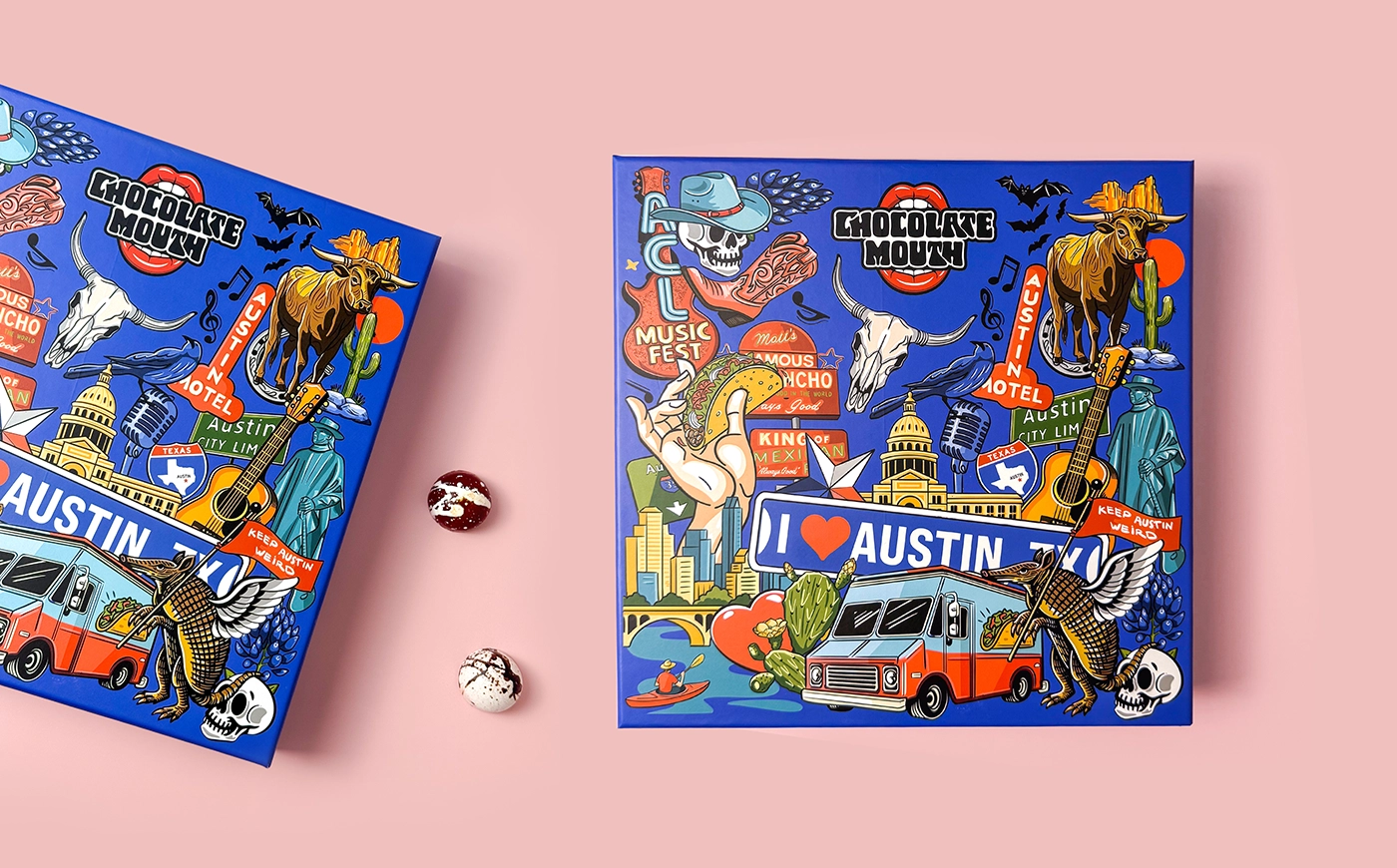
Chocolate Mouth, an artisan confectionery brand in Austin, Texas, sells handmade bonbons in themed gift boxes. We designed the identity and a library of illustrations that lets the brand release a Christmas box, a Valentine’s box, a dog-lover’s box, and a lip-shaped box without starting over each time.


Common candy packaging mistakes
- Designing only the pouch and forgetting the display box that sells it at the register.
- Flavor colors that change from format to format, so the line never looks like a set.
- Illustrations so detailed that the flavor name gets lost.
- A window placed where the candy settles to the bottom, leaving an empty strip of film at eye level.
- Reformulating to natural colors without updating the pack colors, so the candy looks different from the photo.
- Seasonal editions that require a new layout every time.
What candy packaging design costs
Our pricing starts at $2,500, which includes the packaging system and the first SKU. Every additional flavor, size, or seasonal edition is about $800, and a new logo is about $1,500. For a typical example, a gummy brand launching six flavors in pouches would pay $2,500 plus five more SKUs at $800, or $6,500. Add a logo and the total is about $8,000. Display boxes and gift boxes are counted as SKUs too. For a fuller breakdown of what drives the price, see how much packaging design costs.
How we work with candy brands
We’re a design-only studio based in Albany, NY, and we work with brands across the US. Over more than 10 years we’ve completed 80+ packaging projects, including confectionery and chocolate lines. You get three design concepts and up to three rounds of revisions, and after a short call we quote a fixed price, usually within 1–2 business days. A typical project runs two to three weeks from the first call to print-ready files. We don’t print, so the files are prepared for whichever printer or co-packer you already use. If you’re getting ready to reach out, a short packaging design brief will help any studio quote faster. You can see more of our food packaging design work on the service page.
ready to design your candy packaging?
gummies, hard candy, gift boxes, and seasonal editions, with print-ready files for your packaging supplier
get quoteFAQ
01 What is the best packaging for candy?
It depends on the candy. Stand-up pouches work well for gummies and share sizes, tins and rolls suit mints and hard candy, printed wrappers with a counter display box suit lollipops, and folding or rigid boxes with an insert suit assortments and gifts. Pick the format for the place it will sell, then design the system around it.
02 What makes candy packaging attractive?
Clear flavor colors, a big flavor name, a strong brand mark, and a sense of the texture inside, whether that’s sour, chewy, or crunchy. A character or a window can help. The best candy packs look simple from a few feet away and reward a closer look.
03 Does candy packaging need a Nutrition Facts label?
Usually yes. Exemptions include packages with less than 12 square inches available for labeling, if they carry no nutrition claims or other nutrition information and list an address or phone number for nutrition questions, and some small businesses that qualify for the FDA’s small business exemption.
04 Should gummy packaging have a window?
A window shows the real candy, which many shoppers like. It also takes space from the design and shows broken or stuck pieces. Printed photography is a good alternative when the candy’s look varies from bag to bag.
05 Do I have to list food dyes on candy labels?
Yes. Certified color additives must be listed by name in the ingredient list, for example “Red 40” or “Blue 1.” Red No. 3 can’t be used in food after January 15, 2027.
06 Can candy contain a toy or alcohol?
A toy can’t be embedded in the candy under federal law. It can share the package if it’s sealed in its own compartment, and the toy has to meet CPSC safety rules. Alcohol in candy is limited to one-half of one percent by volume, coming only from flavoring extracts, unless the state where it’s sold allows more.
07 How much does candy packaging design cost?
At SOTDESIGN, a candy packaging project begins at $2,500, which pays for the system and one SKU. Each extra flavor, size, or seasonal edition is about $800, and a logo adds about $1,500.