Branding Package: What’s Included and What It Costs
A branding package is a bundled set of brand design deliverables sold at one price: usually a logo with its variations, a color palette, typography, a few core applications such as business cards and social media templates, and a guideline document that explains how to use all of it. Studios sell it in levels. A basic package is a logo and a one-page style sheet; a full brand identity package adds the visual system, stationery, templates, and a brand book. At SOTDESIGN the three levels are a logo at $1,500, a corporate identity from $1,500, and a brand identity from $5,000, and the rest of this guide explains what sits inside each and what is usually missing.
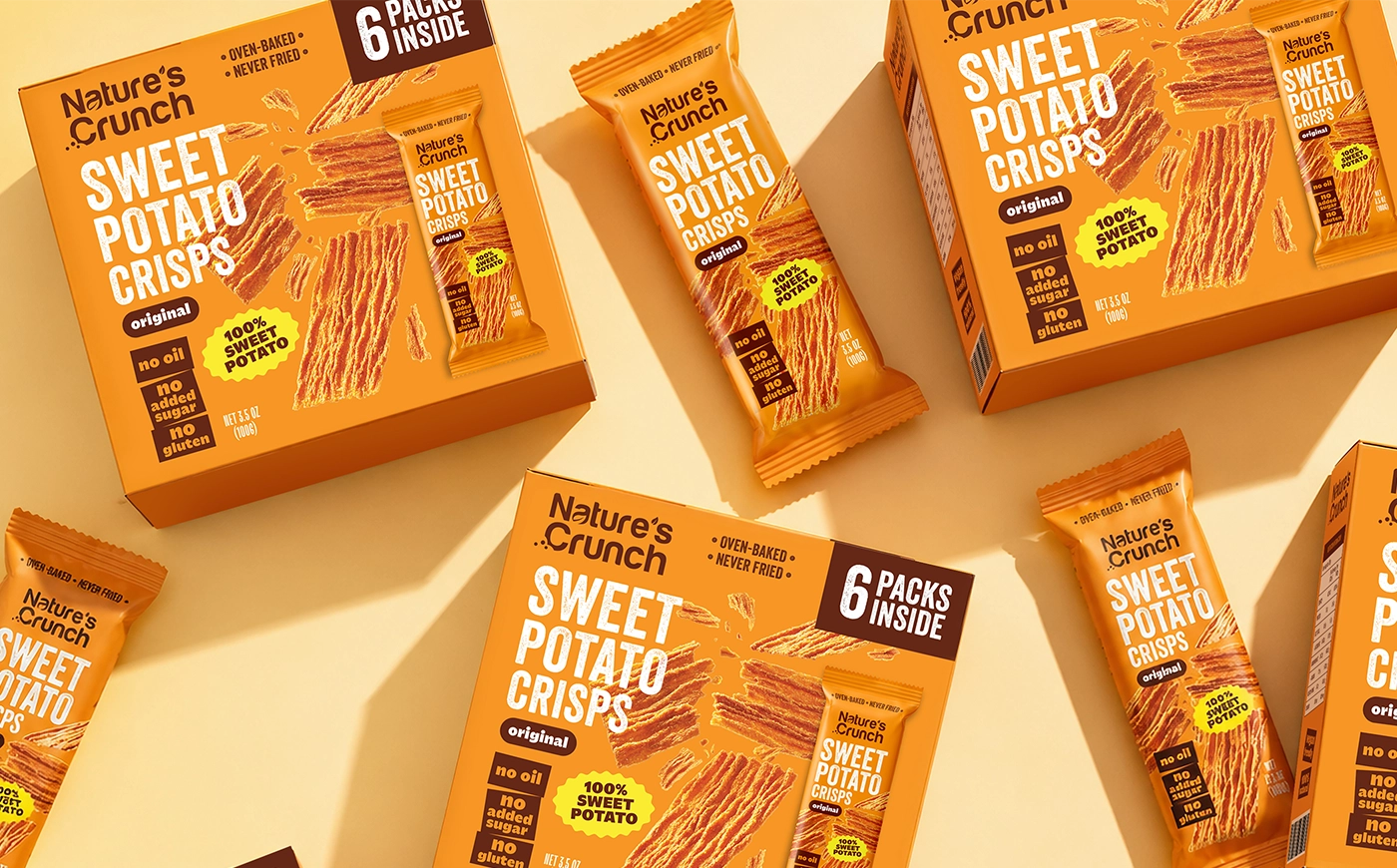
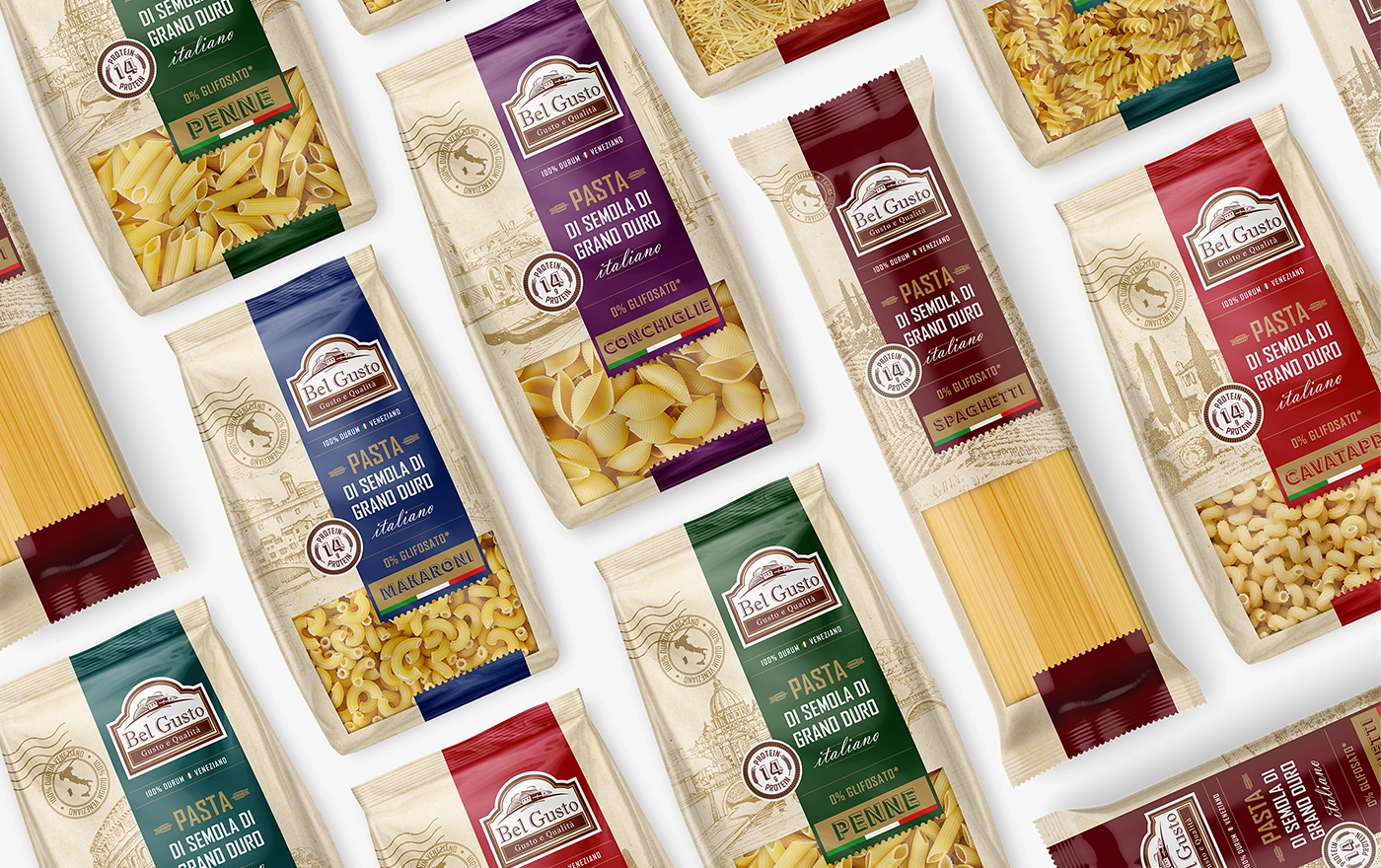
The guide is written for product brands, meaning food, drink, personal care, and other consumer packaged goods that will be sold in a package. That changes the shopping list. For a consultancy, the brand lives on a website and a deck. For a snack or a skincare line, the brand lives on a pouch or a jar, and a branding package that does not plan for packaging leaves the most important application for later.
What a branding package includes, item by item
Names vary from studio to studio, but the contents fall into five groups.
1. The logo system
Not one logo but a family of files that work everywhere the brand appears:
- Primary logo: the full version, usually a symbol plus a wordmark.
- Secondary or horizontal version for wide spaces such as a website header or a label strip.
- Symbol or icon on its own, for a social avatar, a favicon, a bottle cap.
- Wordmark on its own, for places where the symbol does not fit.
- Color versions: full color, one color, black, and reversed (white on dark).
- Clear space and minimum size rules, so nobody squeezes it onto a 10 mm cap and wonders why it looks wrong.
The files should come in vector (AI, EPS, SVG, PDF) for print and raster (PNG, JPG) for screen. If a quote mentions only “logo files” without naming formats, ask.
2. The visual system
This is what makes a brand recognizable when the logo is small or absent.
- Color palette with primary and secondary colors, each given in CMYK, RGB, HEX, and ideally Pantone, because a pouch, a website, and a trade show banner reproduce color differently.
- Typography: a primary and a secondary typeface, with rules for headlines, body, and small print. For a product brand, check that the font has the licensing you need for packaging and that it stays legible at the 6 to 8 point sizes a label uses.
- Graphic elements: a pattern, an illustration style, a photography direction, an icon set. These are the parts that let a range of ten products feel like one brand.
3. Core applications
The first real uses of the identity, designed and delivered as files:
- business card, letterhead, envelope, and a folder for documents (the classic stationery set);
- email signature;
- social media profile and post templates;
- a presentation template;
- sometimes a simple one-page website design or a landing page mock-up.
Which applications a package includes is where studios differ most, and it is the first thing to check against your real needs. A direct-to-consumer brand uses social templates every day and may never print a letterhead.
4. Brand guidelines or a brand book
A guideline is a document, usually a PDF, that shows how to use everything above: logo placement, spacing, color codes, type sizes, do’s and don’ts, and application examples. A basic version runs a few pages. A full brand book adds the strategic layer, a short statement of what the brand stands for, who it is for, and how it speaks, and more application examples.
This document is what protects the investment. Two years in, when a new designer, a printer, or an Amazon listing specialist touches the brand, the guideline is what keeps the result consistent.
5. Strategy and naming, sometimes
Larger packages begin with a discovery phase: interviews, a competitor review, positioning, and a brand platform. Some include naming and a trademark screen against the USPTO database. At most studios these are separate services or add-ons, so if you see “strategy” in a package description, ask how many hours it covers.
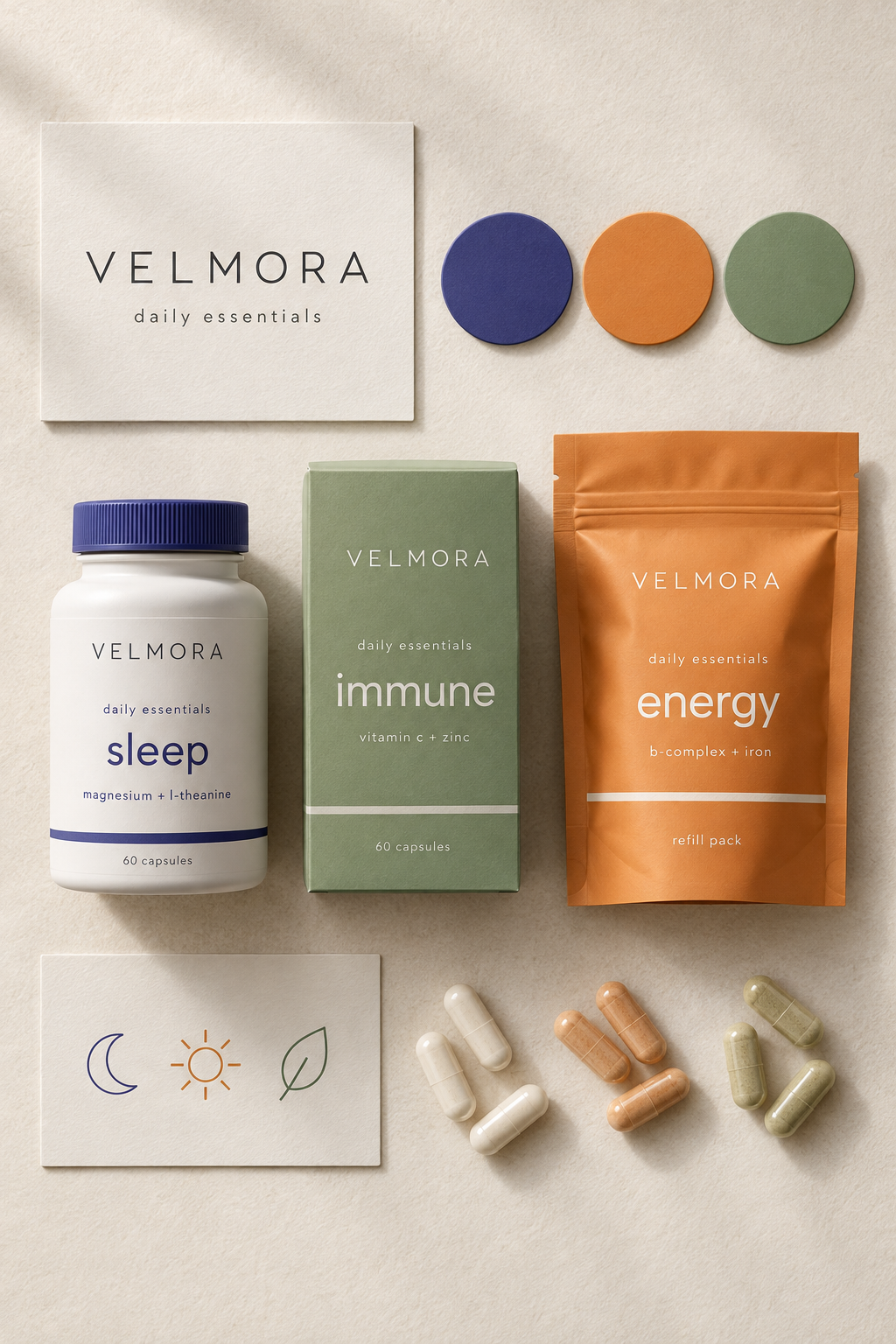
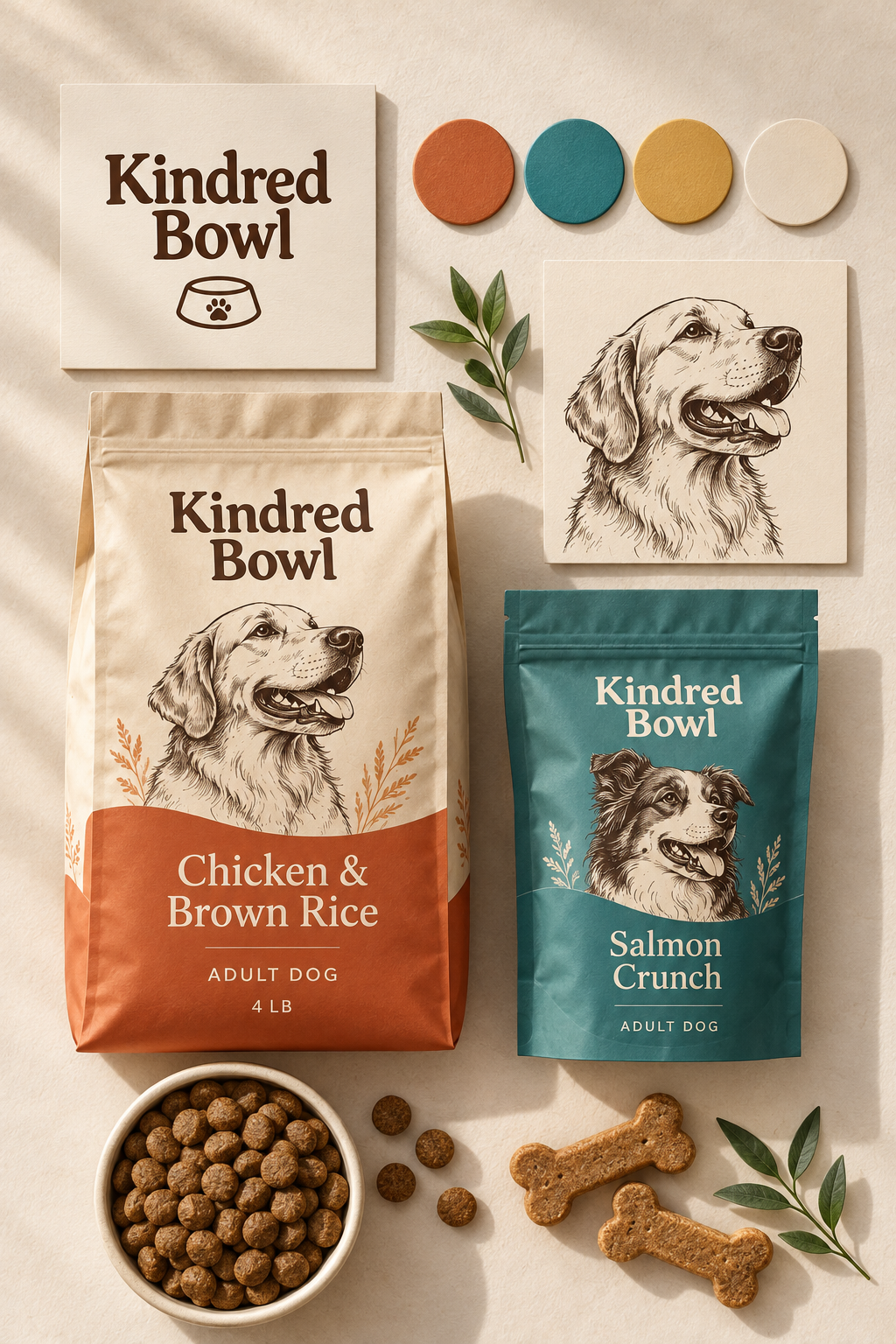
Brand concept by SOTDESIGN: VELMORA (left) and Kindred Bowl (right).
Branding package, brand kit, brand guidelines: the terms
Suppliers use these words loosely, and the confusion costs money.
- Branding package (also brand design package, brand identity package): a bundle of design work sold at one price, as described above.
- Brand kit: usually a lighter thing, the files and codes of an existing brand collected in one place, often inside a tool such as a design app or a print-on-demand site. A brand kit assumes the identity already exists.
- Brand guidelines / style guide / brand book: the document that explains the rules. It is one deliverable inside a package, and it can also be commissioned on its own for a brand that has assets but no rules.
- Visual identity: the design system itself (logo, color, type, graphic elements), as opposed to the brand strategy behind it.
- Brand strategy: the positioning, audience, and message work that ideally precedes design. Sold separately by most studios, included by agencies.
When a vendor says “branding package,” ask which of these they mean. A $300 brand kit and a $5,000 brand identity are both sold under that name.
The three levels most studios sell
Almost every package menu is a version of this ladder. The names change; the structure does not.
| Level | What you get | Who it suits | SOTDESIGN price |
|---|---|---|---|
| Logo | Logo system in all versions and formats, 3 concepts, 3 revision rounds | A brand that already has a visual system, or a very small launch | $1,500, up to 13 days |
| Corporate identity | Stationery (business card, letterhead, folder, envelope) and a guideline built on your existing logo: logo use, typography, colors, patterns, layout rules | A business that has a logo and needs a complete, consistent look for print and digital | From $1,500, up to 20 days |
| Brand identity | Logo and corporate identity plus a brand book: brand overview, logo rules, palette, typography, visual elements, tone of voice, application examples | A product brand building for the long term, especially with a range | From $5,000, up to 35 days |
Each level at our agency includes three concepts and three rounds of revisions, and the exact figure for corporate and brand identity depends on how many elements you add. The service pages for brand identity and logo design list the current contents.
Across the industry the spread is wider. Freelancers and template marketplaces sell “branding packages” from a few hundred dollars, usually a logo with a color palette and no system behind it. Mid-size studios sit between $3,000 and $15,000 for a full identity. Agencies that include research, strategy, and a large application set start around $25,000 and go well past $100,000. The price tracks the number of people and hours in the project more than the quality of the logo itself.
What drives the price
Two packages with the same deliverable list can differ by five times. The difference comes from a handful of inputs.
- Hours of senior time. Discovery interviews, strategy workshops, and research are expensive because a senior person runs them.
- Number of concepts and rounds. Each concept is a separate design exploration; each round is another pass by the team.
- Breadth of applications. Six applications and twenty-six are different projects, even if the logo is identical.
- Range complexity. For a product brand, a system that must cover one SKU and one that must cover thirty are different jobs, because the second needs rules, not just a design.
- Team size. A solo designer, a small studio, and an agency with account managers carry different overheads, and the quote reflects it.
- Speed. Rush timelines usually add 25 to 50 percent.
What does not move the price much is the quality of the idea. A good logo from a small studio and a good logo from an agency cost very different amounts for reasons that have little to do with the mark.
What a branding package usually does not include
This section saves more money than any other. Read a package description for what is absent.
Packaging design. Almost never included, and for a product brand it is the main application. Packaging is its own project because it depends on a physical format, a dieline from your manufacturer, and labeling rules. At SOTDESIGN a system for the first SKU is $2,500 and up, each further variant is around $800, and a label design for a container you already use is from $1,500. The ranges are in our packaging design cost guide.
Website. A landing page mock-up sometimes, a built website almost never. Web design and development are quoted separately.
Naming. Coming up with the brand name, screening it, and filing a trademark are separate work. If you need a name, say so before the package is scoped.
Photography and illustration. The package defines a style; producing the actual photos or custom illustrations is usually extra, or you buy stock within the defined style.
Copywriting. Tone-of-voice guidance may be in the brand book; writing the website or packaging copy is not.
Printing. Studios design; printers print. We do not print or manufacture, and most studios do not either, so the quote for business cards or boxes comes from a third party.
Ongoing design. The package ends at delivery. Monthly design support is a retainer, a different arrangement.
None of this is a trick. It is a reflection of how projects are staffed. But a founder who expects “branding” to cover the pouch and the website is often surprised by the second and third invoices, so settle the full list on day one.
What a product brand should add to the standard package
If your brand will be sold in a package, ask for these alongside the usual deliverables. Some studios include them in a brand identity level; others quote them separately.
- A packaging-ready logo set. Versions that survive embossing, one-color printing on kraft, and reproduction at the size of a bottle cap.
- Color specified for print on your material. A HEX code is not a print specification, and a flexographic printer cannot work from it. Ask for CMYK and Pantone references and, if the budget allows, a drawdown on the actual substrate.
- A type hierarchy for small print. Ingredient lists, allergen statements, and net weight have minimum legibility, and some have legal minimum sizes. The typography rules should cover them.
- Range logic. How will flavor two, size two, and product two look? A single-SKU identity that cannot stretch often forces a redesign within a year or two. Our guide to line extension vs brand extension explains why this is decided at the system level.
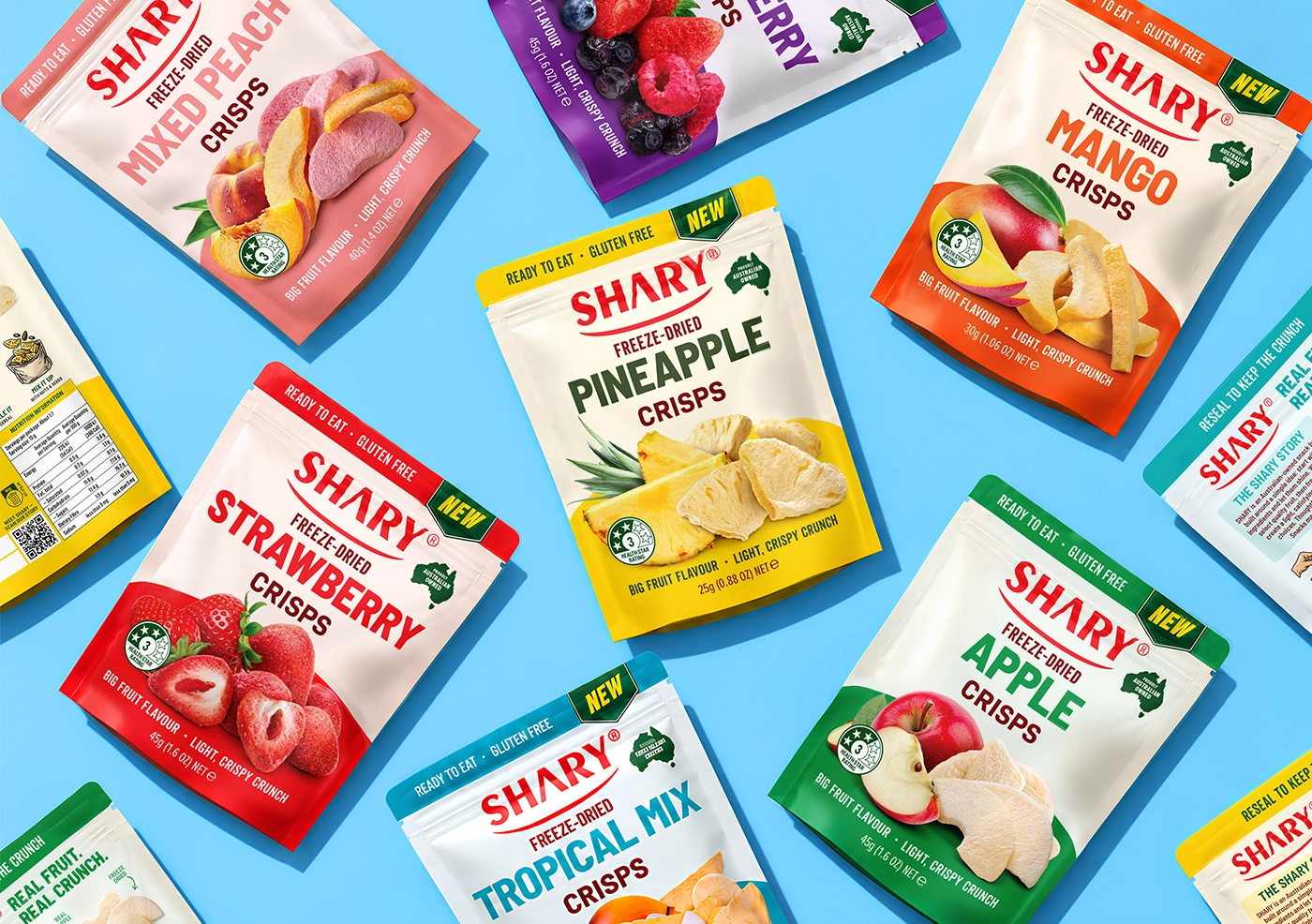
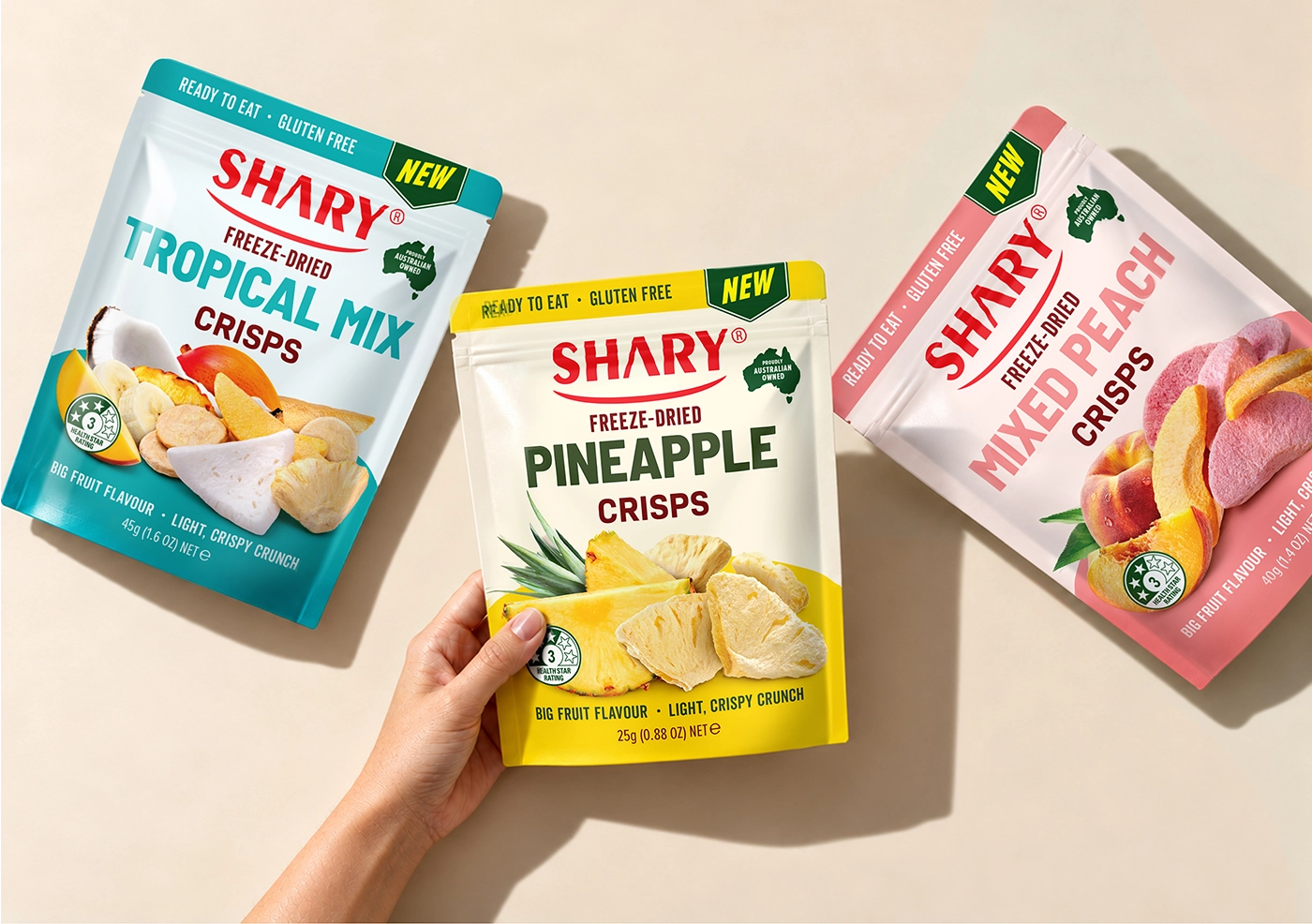
- A front-of-pack hierarchy. Which element reads first, second, third from six feet away. This is the bridge between identity and packaging, and it belongs in the brand book. On the SHARY fruit crisps the order is fixed for all seven flavors: logo, then flavor name, then the fruit-and-crisp photo, then the claims, and that order is what the rest of the range inherits.
- Marketplace assets. A square version of the hero shot, a thumbnail-safe logo, and a template for Amazon or Shopify imagery, because the first time most shoppers see a new product is as an image around 200 pixels wide.
Our work on Fishtime is a good example of why the range logic belongs in the package. The brand book had to govern more than twenty frozen seafood products from the start, so the identity was built as a system, with rules for how product names and images change, before the first pack was designed.
need a brand that's ready for the shelf?
tell us the product, the formats and the range you expect: we’ll scope logo, identity and packaging together · fixed estimate in 1-2 business days
get quoteWhat to prepare before you buy
A package goes faster and lands closer to the mark when the client arrives with these:
- A one-paragraph description of the product and who buys it. Specific enough that a designer could pick it out on a shelf.
- Three to five competitors, with a note on what you like and dislike about each.
- The formats you will sell in, even approximately: a 4 oz pouch, a 12 oz can, a 50 ml jar. The identity should be tested on them.
- The range you expect in two years. One product or twelve, one size or three.
- Channels. Grocery, Amazon, your own site, wholesale. Each adds applications to the list.
- Any assets you must keep. An existing logo, a name, a color your customers already associate with you.
- A real budget range, so the studio can propose the right level instead of guessing.
The studio’s brief will ask for most of this. Having it ready turns the discovery phase from an interview into a confirmation.
How the work runs
A typical branding package at a studio follows the same arc, whatever the level.
Brief and discovery. You fill in a questionnaire about the product, the audience, competitors, and the look you want and do not want. Larger projects add interviews and a competitor review. At our agency this starts with a brief and an estimate within one or two business days.
Concepts. The studio presents several directions, usually two or three, as logo concepts with a sense of color and type. You choose one.
Refinement. The chosen direction is developed through a set number of revision rounds. Three is common. More rounds are possible and usually billed.
System and applications. The palette, typography, and graphic elements are finalized and applied to the items in the package.
Guidelines and handover. The brand book or guideline is written, the files are organized and named, and you receive everything with a short walkthrough.
Across studios, timelines run from about two weeks for a logo to five to eight weeks for a full brand identity, with most of the variance coming from how fast feedback comes back; our own ceilings are in the table above.
Reading a quote line by line
When two quotes look similar and one is a third of the price, the difference is almost always in one of these lines.
- Number of concepts. One concept means you see one idea and iterate on it. Three means a real choice.
- Revision rounds and what counts as a round. Some studios count every email; others count a consolidated set of comments.
- Deliverable list with file formats. “Logo” should mean a logo system in vector and raster. “Guidelines” should say how many pages or what sections.
- Who does the work. A senior designer, a junior, a team, or a subcontractor. Ask.
- Rights. You should own the final work outright on payment. Check for exceptions on fonts (these stay licensed from the foundry) and stock imagery.
- Source files. Ask explicitly for editable source files as well as the exports. Some packages withhold them or charge extra.
- What triggers an extra invoice. Additional applications, extra rounds, rush delivery, print management.
A fair quote reads like a shopping list with quantities. A vague one reads like a promise.
A deliverables checklist you can paste into a request
Use this when you ask studios to quote, and have each one mark what is included, what is extra, and what is not offered.
Logo
- primary, secondary, symbol, wordmark
- full color, one color, black, reversed
- vector (AI, EPS, SVG, PDF) and raster (PNG, JPG) files
- clear space and minimum size rules
Visual system
- primary and secondary palette in CMYK, RGB, HEX, Pantone
- primary and secondary typefaces with licensing notes
- graphic elements: pattern, icons, illustration or photography direction
Applications
- business card, letterhead, envelope, folder
- email signature
- social profile and post templates
- presentation template
- packaging front-of-pack hierarchy (for product brands)
- marketplace image template (for product brands)
Documentation
- guideline or brand book, with page count or section list
- editable source files for everything above
Terms
- number of concepts, number of revision rounds
- timeline with milestones
- rights transfer on final payment
- what triggers additional charges
A studio that fills this in without hesitation is a studio that has scoped this kind of work before.
Common mistakes when buying a branding package
Buying the logo level and expecting an identity. A logo alone does not make ten pouches look like one brand. If you have a range, add the corporate identity level or go straight to brand identity.
Choosing by price per deliverable. Twenty templates you will never use are not better value than six you will.
Skipping the guideline to save money. It is the cheapest line in the package and the one that stops the brand from drifting the moment someone else touches it.
Designing the brand before the packaging format is known. A palette chosen for a website may not print on kraft paper or survive a one-color label. For a product brand, the format should be known before the identity is finalized, or at least before it is approved.
Treating the brand book as the finish line. It is the starting document for packaging, the website, and every listing. Budget for those as the next steps so they do not arrive as surprises.
When a package is the wrong purchase
A branding package suits a new brand or a full rebrand. It is the wrong buy in two situations. If you already have a logo and system you like and just need a pouch, you need packaging design, not a package. And if an existing brand has drifted, with three logo versions and five shades of the main color in circulation, the first job is an audit and clean-up, which our rebranding checklist walks through, and the package decision comes after.
New brand or rebrand: the package changes shape
The same three levels apply to both, but the contents shift.
For a new brand, the package is mostly creation: concepts, a system built from nothing, applications designed once. The risk is building an identity that looks good in a presentation and fails on the first pouch, which is why the format question above matters so much.
For a rebrand, part of the budget goes to work that is not design at all: an audit of what exists, a decision on what to keep (often the name and some equity in the logo or color), a migration plan for packaging already on shelves, and a rollout across every place the old brand lives. A rebrand package should name those steps, and the guideline should include a transition section that says which old materials can be used up and which must be pulled. The ZEBRA project below is a typical case: the logo stayed, with small adjustments, and the package was really a new system for a whole varnish line, built so that every SKU moved onto it together.
If you are between the two, a refresh that keeps most of the identity and tightens it, ask for a scoped-down corporate identity level with an audit at the front. Paying for three new logo concepts you have already decided not to use is the most common way a refresh overspends.
Three projects where identity met packaging
SDR Italian Coffee was identity and packaging together: a logo and visual system built for a coffee range, where the identity and the first bags were developed in the same project so that the identity was proven on a real pack before it was finalized.
ZEBRA kept its logo, with small adjustments, and rebuilt the system around it, which is the typical shape of a rebrand package: the mark stays, the palette, typography, and packaging structure change, and the whole line moves together.

Bouncy Body shows a young brand’s package in practice: a playful identity carried across a series of pouches, where the brand elements had to work on a small format and in a crowded personal care shelf from the first SKU.
What a branding package costs at SOTDESIGN
Logo design is $1,500 with three concepts and three rounds, delivered in up to 13 days. Corporate identity starts at $1,500 for stationery and a guideline built on your logo, up to 20 days. Brand identity starts at $5,000 and adds the full brand book, up to 35 days. Packaging is quoted alongside when you need it: a system from $2,500, a label from $1,500. Prices are fixed in the estimate you receive after the brief, usually within one or two business days.
SOTDESIGN is based in New York, and has spent 10+ years on brand identity and packaging for consumer brands, with 80+ packaging projects behind it. Design only; the files are yours and go to any printer. If you need the full set, SOTDESIGN, a CPG branding agency, scopes identity and packaging as one project.
ready to brand your product?
logo, identity and packaging scoped together · design only, source files included · fixed estimate in 1-2 business days
get quoteFAQ
01 What is included in a branding package?
A logo system in all versions and formats, a color palette, typography, a set of core applications such as stationery and social templates, and a guideline or brand book. Higher levels add strategy, more applications, and a fuller brand book.
02 What does a branding package cost?
From a few hundred dollars for a template-based logo to six figures at a large agency. At SOTDESIGN a logo is $1,500, a corporate identity starts at $1,500, and a full brand identity starts at $5,000.
03 Does a branding package include packaging design?
Usually not. Packaging depends on a physical format and labeling rules, so it is scoped separately. At our agency a packaging system starts at $2,500 and a label at $1,500, and we quote them together with the identity when you ask.
04 What is the difference between a logo package and a brand identity package?
A logo package delivers the mark and its variations. A brand identity package adds the full visual system, applications, and a brand book that explains how to use everything.
05 How long does the work take?
Across the industry, about two weeks for a logo, three to four for a corporate identity, and five to eight weeks for a full brand identity, depending on how quickly feedback comes back. At SOTDESIGN the ceilings are 13, 20 and 35 days.
06 Do I own the branding after the project?
You should. Check that the contract transfers rights on final payment and that you receive editable source files. Fonts are licensed from their foundries and stock images from their libraries, so those come with their own terms.
07 Can I buy a branding package and add packaging later?
Yes, and many brands do. Tell the studio about the packaging plan at the start so the identity is built to work on your format, even if the pack itself is designed in a second project.